


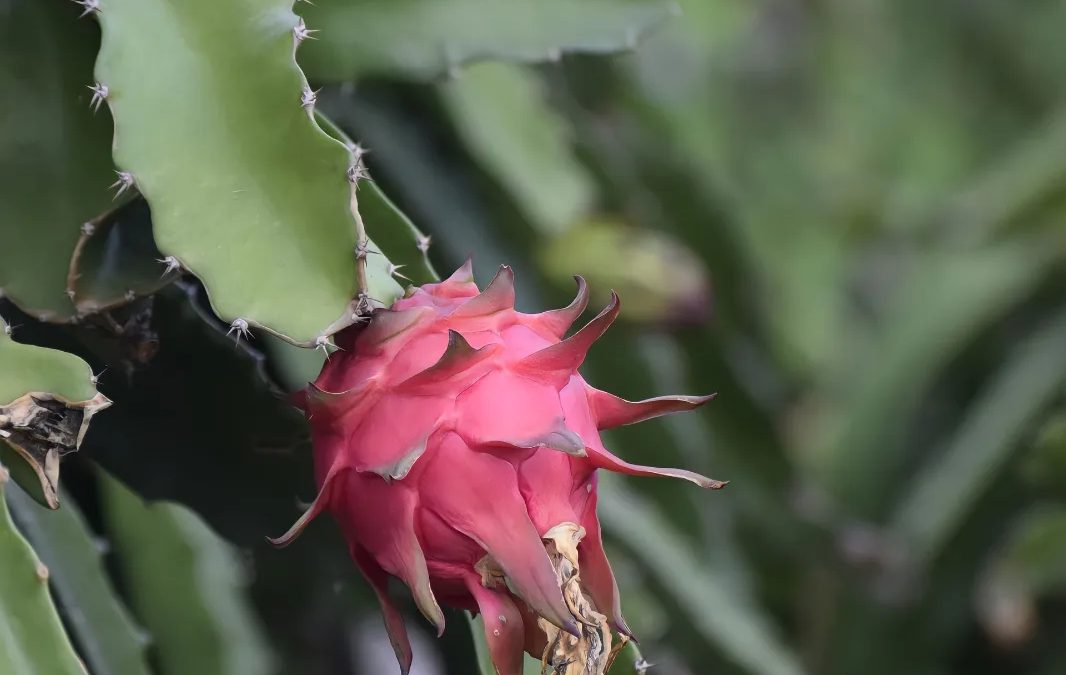

Dragon fruit is a fast-growing climbing cactus that suits warm parts of Australia. The long fleshy stems produce huge night-opening flowers followed by bright pink, red or yellow fruit.
Support has a big effect on how well the plant flowers and how easy the crop is to pick. Train a main stem up a strong post, then let mature branches hang from the top; those hanging stems carry much of the flowering and fruiting.
Give dragon fruit warmth, good drainage and regular moisture during active growth. Tropical and subtropical gardens suit it particularly well, and warm temperate or Mediterranean gardens can grow it in a sheltered position.
- Botanical name: Selenicereus spp.
- Also known as: Pitaya, Pitahaya
- Category: Vine
- Lifecycle: Perennial climbing cactus
- Climates: tropical, subtropical, temperate, arid inland, Mediterranean
- Position: Warm full sun. In very hot exposed sites, young stems can need temporary protection while they establish.
Dragon Fruit Growing Conditions at a Glance
- Botanical name: Selenicereus undatus and other Selenicereus species and hybrids
- Older botanical name: Hylocereus undatus
- Also called: Dragon fruit, dragonfruit, pitaya and pitahaya
- Plant type: Perennial climbing cactus
- Climates: Tropical and subtropical are easiest; warm temperate, Mediterranean and arid areas can also grow dragon fruit with the right position and care
- Light: Full sun, with some protection from extreme scorching sun if stems are burning
- Soil: Fertile but very well drained
- Water: Regular during active growth, flowering and fruit development
- Feeding: Moderate
- Support: Essential
- Flowering: Mainly during the warmer months
- Fruit: Usually develops within several weeks of successful pollination
- Propagation: Cuttings are easiest
- Main problems: Poor drainage, weak supports, sunburn, stem rot and poor pollination
- Important in Australia: Dragon fruit has escaped cultivation and is regarded as an environmental weed in parts of eastern Australia
Where Does Dragon Fruit Grow in Australia?
Dragon fruit is very well suited to northern Australia.
Commercial crops are grown in the Northern Territory, Queensland, Western Australia and New South Wales, with much of Australian production coming from the Northern Territory and Far North Queensland.
Warmth makes a big difference to how quickly the plant grows and fruits.
In tropical and subtropical areas, dragon fruit can grow vigorously outdoors.
In warm temperate areas, choose the warmest sunny position you have.
In Mediterranean climates such as Perth, dragon fruit can also fruit successfully, although plants usually grow more slowly through winter.
Cool and mountain climates are much harder. Frost can damage the fleshy stems and cold weather slows growth considerably. A greenhouse or very sheltered warm position gives you a much better chance.
Arid inland areas can suit dragon fruit well if you provide irrigation and protect the stems from extreme sunburn.
Where Should You Plant Dragon Fruit?
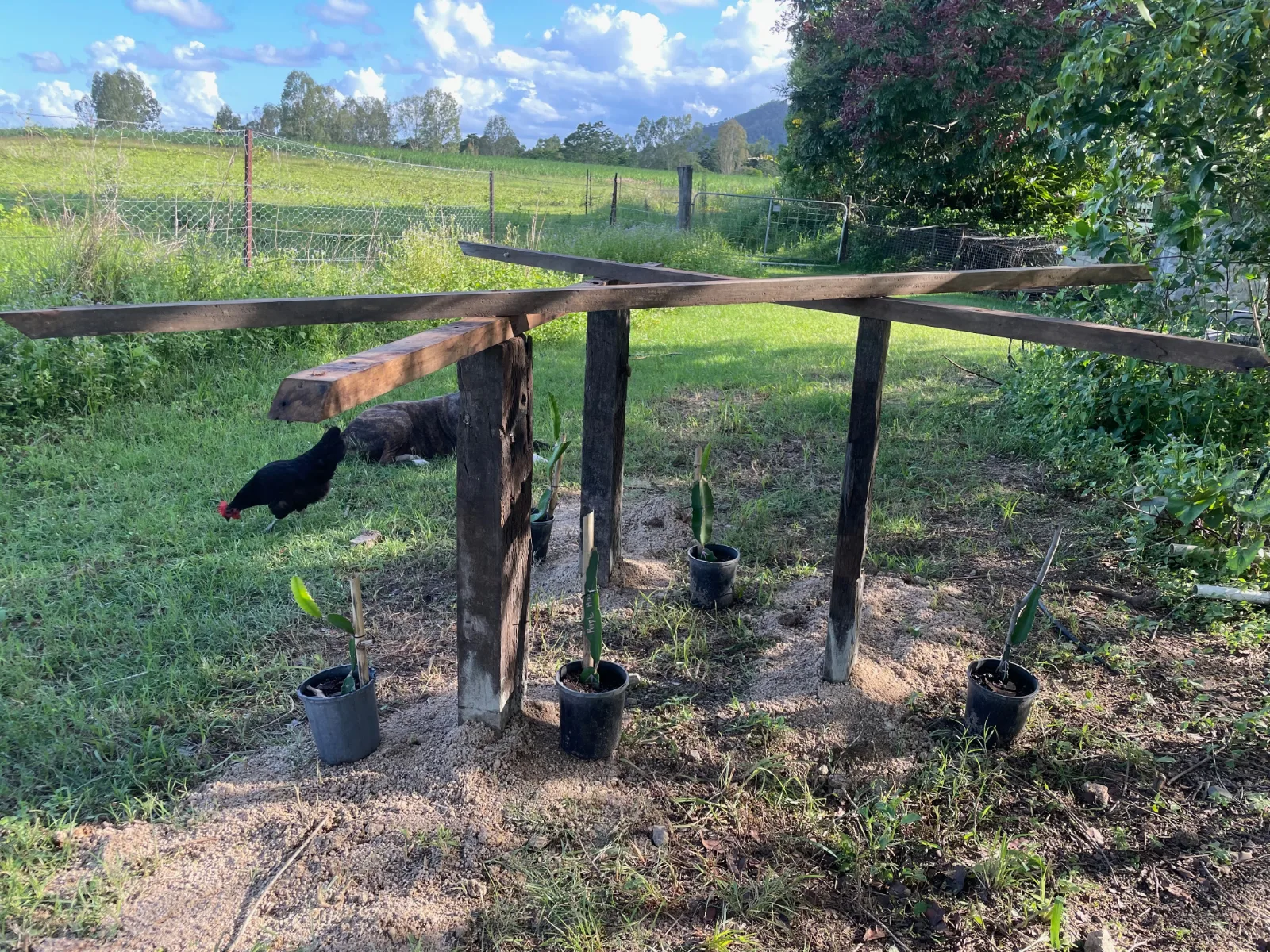
Start with the support.
Do not plant a dragon fruit and assume you can work out what to hold it up with later.
A mature plant becomes heavy.
It can produce a mass of thick water-filled stems hanging from the top of its support, followed by flowers and large fruit.
I would use:
- a strong concrete post
- a substantial hardwood post
- a properly anchored metal structure
- a very solid trellis
- a purpose-built dragon fruit post with a frame at the top
Aim for a support that lets the main stems climb roughly 1.5–2 m before they spill over the top.
You can also train dragon fruit along a strong fence or horizontal trellis.
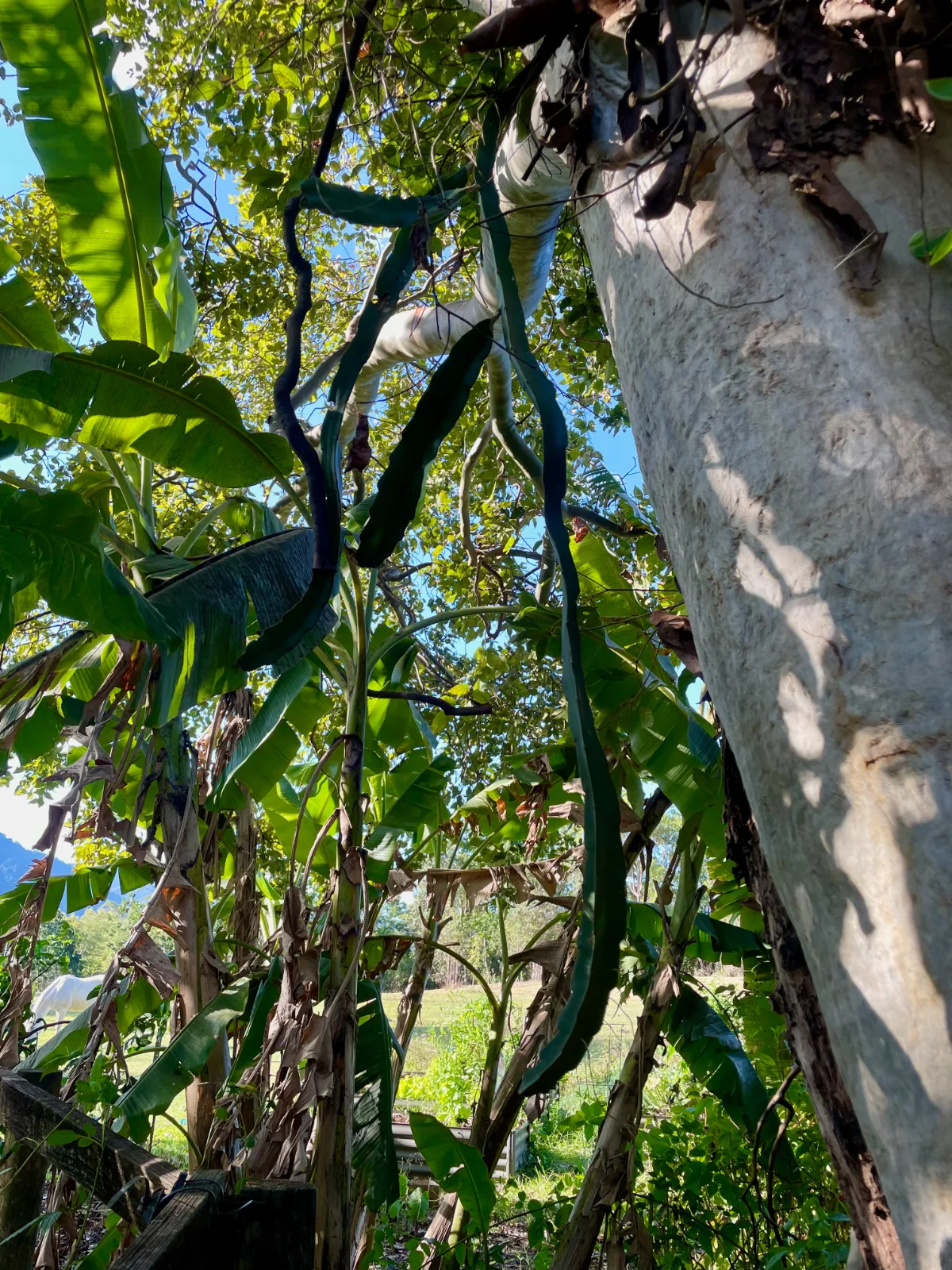
I would not deliberately let it climb a living tree in Australia. Apart from making the fruit difficult to reach, escaped dragon fruit can climb over native vegetation and become extremely difficult to remove.
Give the plant room around the support.
A mature dragon fruit can easily spread a couple of metres once the hanging canopy develops.
Why Does Dragon Fruit Need to Hang Down?
This is one of the most useful things to understand about the plant.
Dragon fruit naturally climbs upwards using aerial roots.
If you simply let every stem keep travelling vertically, you can end up with an impressive cactus and very little useful fruiting structure.
The usual method is to train one or several strong stems up a post.
Once they reach the top, let new branches bend and hang down.
Those hanging lateral branches are important flowering and fruiting wood.
So the basic shape is:
- Strong upright support.
- Train stems upward.
- Remove unnecessary low side growth while establishing the main leaders.
- Let branches spread over the top.
- Allow those branches to hang down.
- Prune later to stop the canopy becoming an enormous tangled mess.
How to Plant a Dragon Fruit Plant
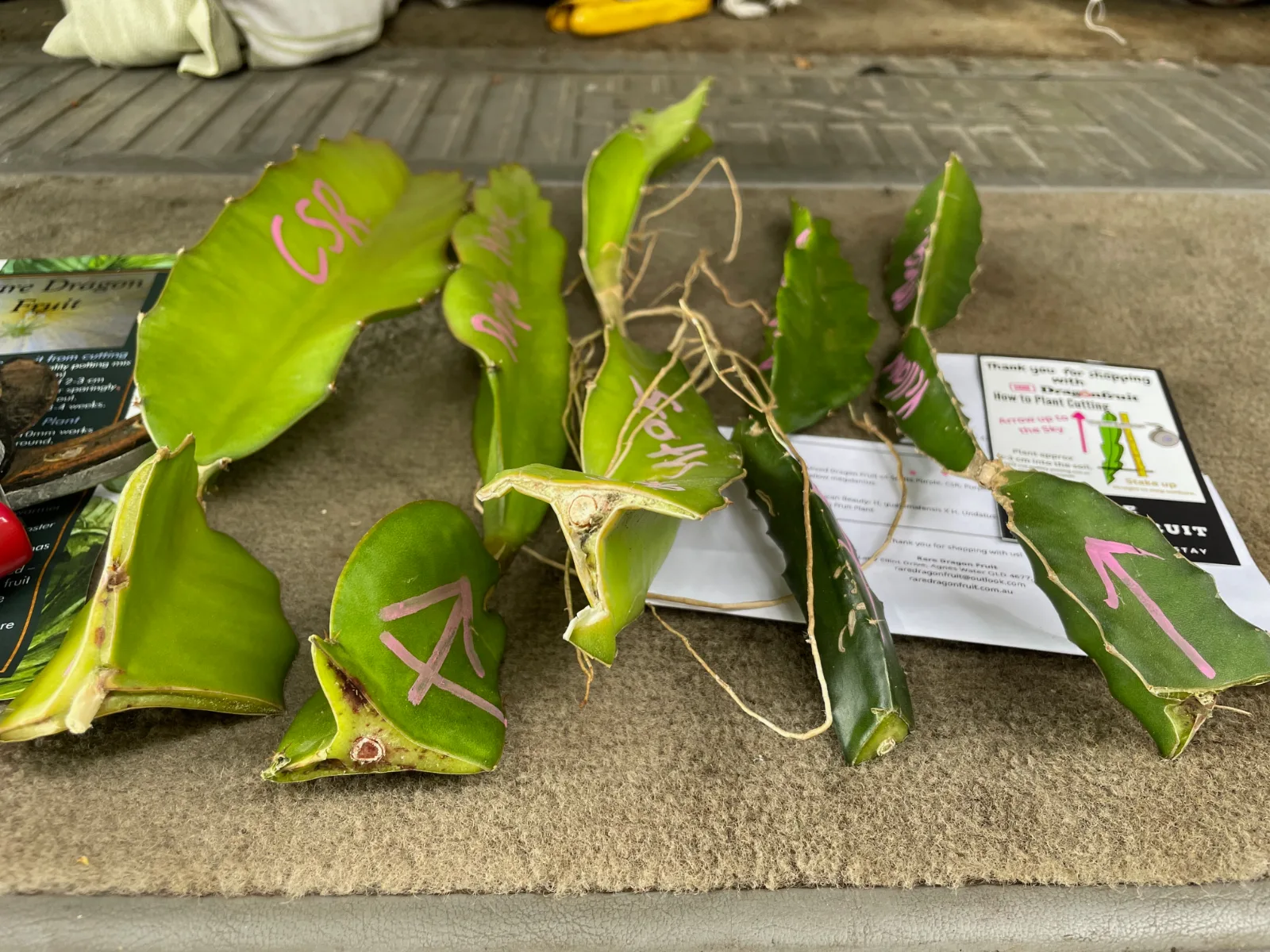
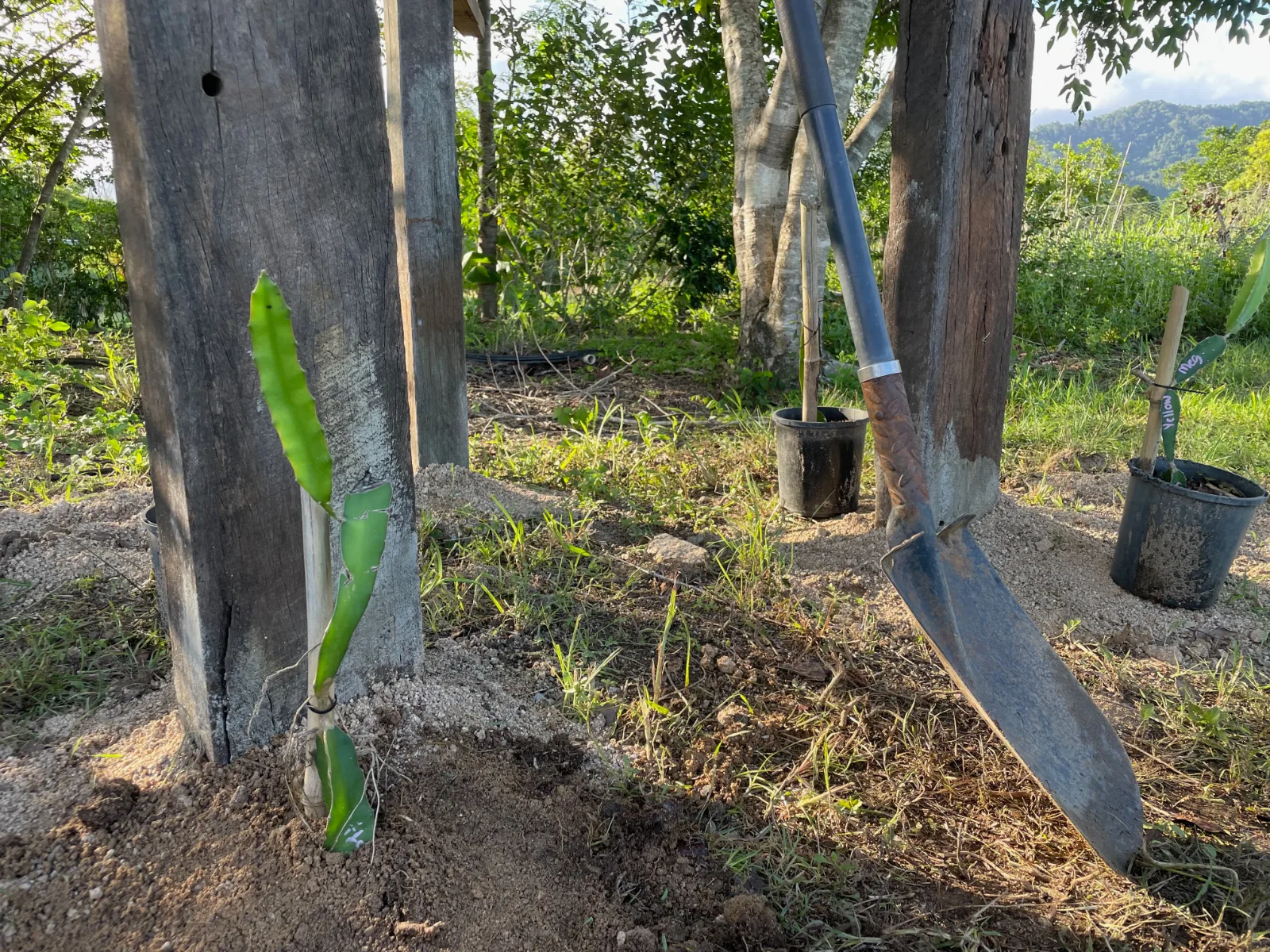
If you have bought a rooted plant or established cutting, get the support in place first.
Then:
- Choose a warm position with excellent drainage.
- Install the support before planting.
- Dig a hole slightly wider than the root ball.
- Plant at roughly the same depth the plant was growing in its pot.
- Firm the soil gently.
- Water it in.
- Loosely tie the main stem to the support.
Use soft ties.
Dragon fruit stems are fleshy and can be damaged by wire or tight cord.
As the stem grows, keep tying it upward until it reaches the top of the structure.
You may notice aerial roots growing from the stem and gripping the support. That is normal.
Best Soil for Dragon Fruit
Dragon fruit needs good drainage, but it does not need cactus-desert conditions.
That distinction matters.
These plants come from warmer regions where climbing cacti often grow with access to organic matter and regular moisture.
A good garden soil for dragon fruit is:
- free draining
- reasonably fertile
- rich enough to support strong growth
- not waterlogged after rain
If you have heavy clay, I would plant on a mound or raised area rather than putting dragon fruit into a low wet spot.
The Northern Territory growing guidance recommends well-drained raised beds for commercial plantings.
Dragon fruit has a shallow feeding root system. A lot of its roots sit within the upper part of the soil.
Mulch can help keep this root zone cooler and more evenly moist.
Keep thick mulch a little away from the base of the plant so the stem is not constantly damp.
Can You Grow Dragon Fruit in a Pot?
Yes.
Dragon fruit grows very well in a large container.
The challenge is not really fitting the roots into a pot. The challenge is stopping the whole thing from falling over once the top becomes heavy.
Choose a large, broad and heavy container with plenty of drainage holes.
Install the support securely inside the pot before planting.
A narrow lightweight plastic pot with a two-metre dragon fruit on top is asking for trouble.
Use a good-quality potting mix with extra drainage if needed.
Gardening Australia recommends a premium potting mix with material such as sand or perlite added to improve drainage.
Container plants dry faster than plants in the ground, so check them regularly during hot weather and while fruit is developing.
How Much Sun Does Dragon Fruit Need?
Give dragon fruit plenty of sun.
For most Australian gardens, full sun is a good starting point.
Sun helps build strong growth and supports flowering.
There is a catch in very hot exposed climates.
Dragon fruit stems can sunburn.
Intense heat and harsh afternoon sun can cause pale, yellow or damaged patches on exposed stems. Damaged tissue can then become vulnerable to rot.
Newly established plants are more vulnerable than mature plants that have gradually adapted to the site.
If you live somewhere brutally hot, temporary shade cloth or protection from the worst western afternoon sun can be useful.
Do not move a shade-grown dragon fruit straight into fierce summer sun and expect it to cope immediately.
Harden it off gradually.
How Often Should You Water Dragon Fruit?
Dragon fruit is a cactus, but it grows and fruits best with regular moisture during active growth. Its fleshy stems store water and its roots are relatively shallow, so young plants establish more quickly with steady watering.
Once established, let the upper soil begin to dry before watering again. Keep moisture reasonably even through flowering and fruit development because sharp swings from very dry soil to heavy watering can contribute to fruit splitting.
Rainfall may cover most of its needs through a wet tropical season. Pots in a hot, dry summer need checking more often. Check the soil before watering rather than following the calendar.
Does Dragon Fruit Need Fertiliser?
Yes, but you do not need to attack it with fertiliser every week.
Dragon fruit is more productive with some nutrition than a typical desert cactus.
Young plants need enough nitrogen to build their climbing framework.
Once plants are established and approaching flowering, I would avoid continually pushing huge amounts of soft green growth with high-nitrogen fertiliser.
A sensible home-garden program might include:
- compost or well-rotted organic matter
- a complete fruiting fertiliser
- pelletised organic fertiliser
- occasional liquid feeding during active growth
Feed according to the product directions rather than assuming more is better.
Container plants will need nutrients replaced more regularly because they cannot forage beyond the pot.
When Does Dragon Fruit Flower in Australia?
Flowering generally happens during the warmer months.
Timing varies considerably with climate and variety.
In the Northern Territory, flowering and fruit production are concentrated through the warmer part of the year.
Queensland harvests generally run later into autumn and early winter than the main Northern Territory season.
You may get several flushes of flower buds during a warm growing season rather than one enormous flowering event.
The buds start small and then develop into enormous flowers.
What Do Dragon Fruit Flowers Look Like?
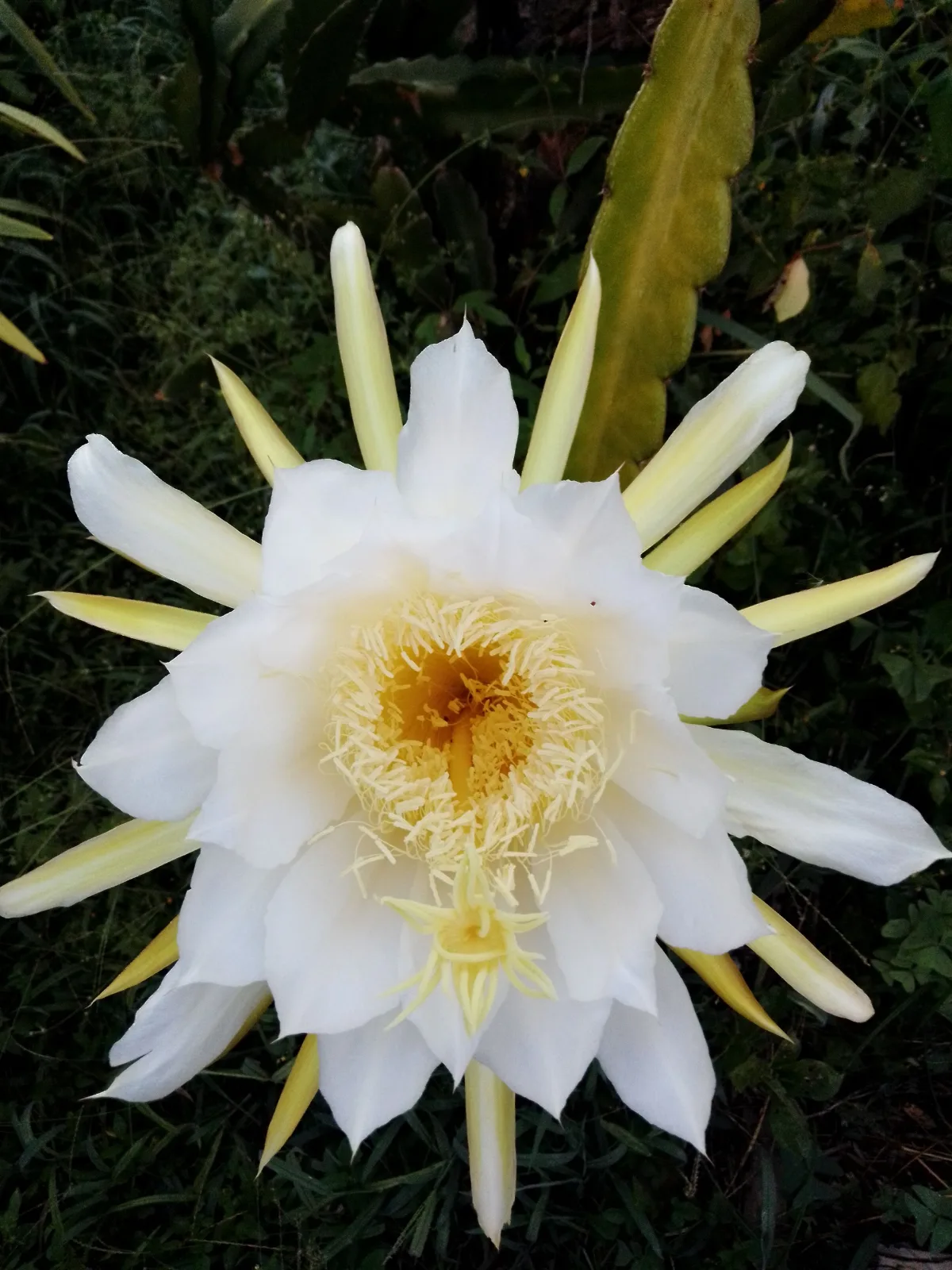
They are spectacular.
Dragon fruit produces huge white or cream flowers that can reach around 30 cm across.
They are fragrant and open at night.
A flower may look ready to open all afternoon, then suddenly unfurl after dark.
By the following morning it is already beginning to close.
If you have never seen one flower, it is worth going outside with a torch.
A mature plant covered in open dragon fruit flowers is one of the more ridiculous things you can grow in a backyard.
Does Dragon Fruit Need Hand Pollination?
Sometimes.
This depends heavily on the variety.
Some dragon fruit cultivars are self-fertile or self-compatible and can set fruit using their own pollen.
Others are self-incompatible and need pollen from a genetically different dragon fruit.
Even self-fertile varieties can sometimes set larger or more reliable crops with good cross-pollination.
This is why buying a known named variety from someone who understands its pollination requirements is much better than buying an unidentified cutting and hoping for the best.
If you have room, growing two different compatible varieties gives you more options.
Natural pollinators visit the huge flowers at night and around dawn.
In Australia you may also see bees working flowers that remain open into the morning.
If your plant flowers beautifully but repeatedly fails to make fruit, pollination is one of the first things I would investigate.
Grow a Little Wild
New plants to try, useful growing tips and a few garden jobs based on what you grow.
How to Hand Pollinate Dragon Fruit
Hand pollination is simple.
Do it at night while the flower is fully open, or very early the following morning.
You will see many pollen-covered stamens surrounding the centre of the flower.
The stigma sits prominently in the middle.
To hand pollinate:
- Use a small clean brush or collect some loose pollen.
- Pick up pollen from the stamens.
- Brush it generously onto the stigma.
- If your variety needs cross-pollination, use pollen from a different compatible plant.
You can also remove pollen-bearing stamens and gently rub them over the stigma.
If you have several varieties flowering together, cross-pollinate them rather than relying entirely on self-pollination.
Why Is My Dragon Fruit Flowering but Not Fruiting?
Pollination is the obvious possibility, but not the only one.
Check:
- Variety: Some need compatible pollen from another dragon fruit.
- Pollinators: A flower that opens overnight has a short pollination window.
- Weather: Heavy rain can interfere with pollination.
- Plant age: Young plants may flower inconsistently.
- Nutrition: Excessive nitrogen can favour stem growth over flowering and fruiting.
- Sun: Heavily shaded plants can be less productive.
- Structure: Dragon fruit flowers heavily from mature hanging branches.
If you bought an unnamed plant, identifying the variety can solve a lot of frustration.
How Long Does Dragon Fruit Take to Produce Fruit?
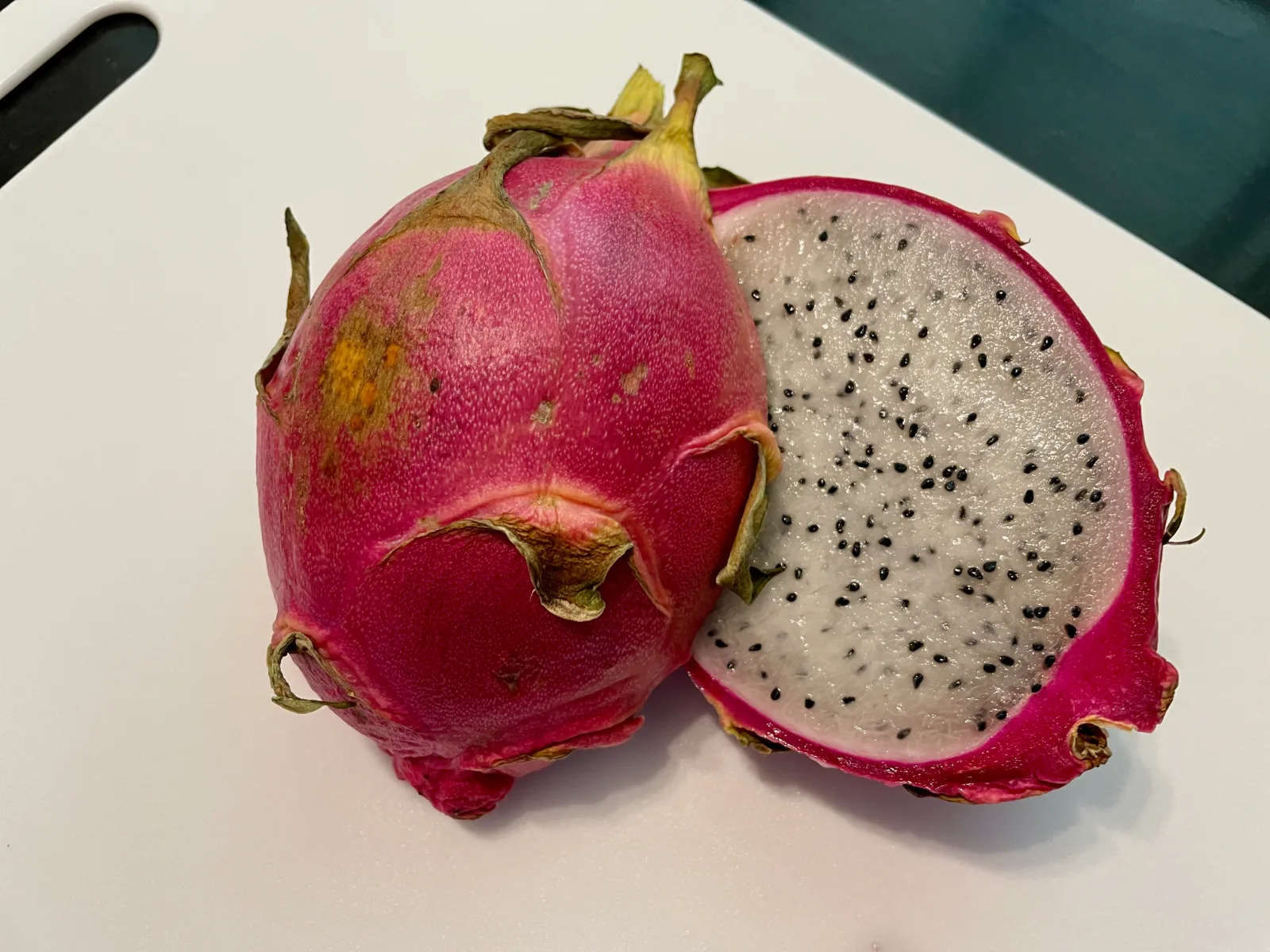
Plants grown from cuttings are much faster than seedlings.
A well-grown cutting in a warm climate may produce its first fruit quickly.
Do not expect maximum production immediately.
Gardening Australia notes that cuttings can sometimes begin fruiting within a year under good conditions, but a proper crop generally takes two to three years.
In cooler places it can take longer.
In Perth, for example, Gardening Australia reports around three years from a cutting as a reasonable expectation.
How to Prune Dragon Fruit
Dragon fruit benefits from regular pruning.
Without it, the top of the support can turn into a dense knot of stems.
A crowded plant is:
- harder to harvest
- harder to check for insects feeding on the stems
- harder to hand pollinate
- more humid inside the canopy
- heavier on the support
Once the plant has built its basic framework, remove:
- damaged stems
- diseased stems
- weak growth
- stems growing into the centre
- excessive old growth
- branches that make access difficult
Keep plenty of healthy hanging branches for flowering.
Late winter or after the main harvest is a useful time for a larger tidy-up, depending on your climate.
In the tropics, I would work around the plant's own flowering and harvest cycle rather than pruning just because the calendar says August.
Can You Propagate Dragon Fruit From Cuttings?
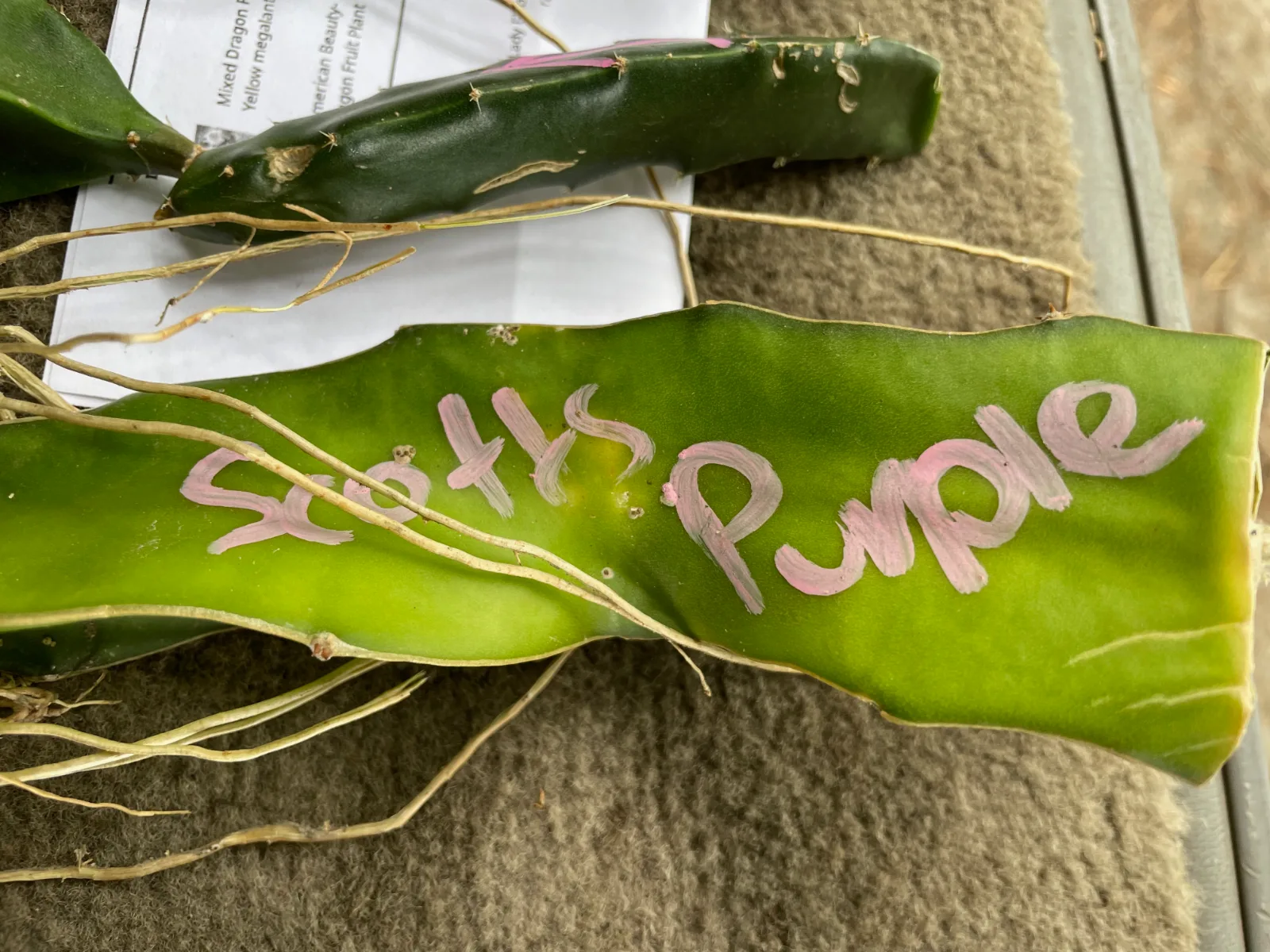
Very easily.
Cuttings are the best way to propagate a good dragon fruit because they are faster and more predictable than seed.
Choose a healthy mature stem.
A cutting around 30 cm long is a useful size.
If you cut through fresh fleshy tissue, leave the cutting somewhere dry and shaded for several days until the wound calluses.
Northern Territory guidance recommends curing cuttings for about a week before potting.
Once callused:
- Plant the base into a free-draining potting mix.
- Keep it warm.
- Do not saturate the pot before roots develop.
- Keep it protected from harsh sun while it has no roots.
- Gradually increase sun exposure once it begins growing.
Dragon fruit can also root from pieces that fall onto the ground.
That is handy when you want more plants.
It is less handy when pieces have been dumped near bushland.
Can You Grow Dragon Fruit From Seed?
You can.
I generally wouldn't bother if fruit is your main goal.
Seedlings are slower and genetically variable.
A seed-grown plant may not produce fruit exactly like the fruit the seed came from.
Cuttings from a known productive plant give you a much better idea of what you are going to get.
There is also an Australian biosecurity reason not to casually plant seeds from imported supermarket fruit.
Use propagation material from reputable Australian nurseries or local plants rather than planting imported food products.
When Is Dragon Fruit Ready to Pick?
Wait for the fruit to develop its full skin colour.
Red and pink varieties should become strongly coloured rather than remaining partly green.
Yellow varieties change to their mature yellow colour.
Dragon fruit is non-climacteric.
That means it does not continue improving after harvest in the same way a banana does.
Fruit picked too early may colour further, but it will not develop the same flavour and sweetness as fruit allowed to mature properly on the plant.
In warm conditions, fruit can develop remarkably quickly after flowering.
Northern Territory trials recorded harvest at around four weeks after the flower closed, although variety and weather can stretch that timing.
Use colour and maturity rather than counting an exact number of days.
Cut the fruit from the plant rather than twisting aggressively and damaging the stem.
Why Is My Dragon Fruit Splitting?
Uneven water is a common cause.
Dragon fruit needs moisture while the fruit is expanding.
If the plant becomes very dry and then suddenly receives a large amount of water, the fruit can swell quickly and split.
Try to keep moisture more consistent during fruit development.
Heavy rainfall can make this difficult in tropical Australia.
You cannot control the weather, but good drainage prevents the roots sitting underwater after a storm.
Common Dragon Fruit Problems
Stem rot
Soft watery patches can develop after injury or during prolonged wet conditions.
Cut away badly affected material with clean tools.
Improve drainage and airflow.
Do not leave the base of the plant buried in soggy mulch.
Sunburn
Strong exposed sunlight can scorch the fleshy stems.
This is more likely when a plant has suddenly moved from shade into full sun.
Protect young or newly moved plants while they acclimatise.
Very hot inland and tropical western exposures may benefit from some afternoon protection.
Mealybugs and scale
Check the joints, crevices and shaded parts of the stems.
Small infestations are much easier to deal with than a plant covered in insects.
Ant activity can be a clue that sap-feeding insects are present.
Slugs and snails
Young growth can be damaged by slugs and snails, particularly during wet weather.
Check around the base at night if new shoots are being eaten.
Caterpillars and beetles
These may chew stems, flowers or young growth.
Inspect damage before treating anything. A few holes do not necessarily require intervention.
Fruit flies
Dragon fruit can be affected by fruit flies.
Fruit-fly pressure varies around Australia.
Follow current advice for your state or territory rather than relying on old spray recommendations.
Birds, rats and other animals
Ripe dragon fruit is not only attractive to humans.
Fruit close to harvest may need protection if birds, rats or other animals discover it.
Why Is My Dragon Fruit Turning Yellow?
First work out whether you are looking at general yellowing or a damaged patch.
A pale bleached area on the sun-facing side can be sunburn.
Yellowing associated with soft or collapsing tissue can indicate rot.
Whole plants becoming pale may point to:
- poor drainage
- root damage
- nutrient problems
- prolonged cold
- excessive water
- badly exhausted potting mix
Check the roots and growing conditions before adding more fertiliser.
Does Dragon Fruit Tolerate Frost?
Not well.
Dragon fruit prefers warm, frost-free conditions.
A light cold spell may not kill an established plant, but frost can damage soft stems and cold weather slows growth considerably.
In frost-prone parts of Australia:
- plant against a warm north-facing wall
- avoid frost hollows
- protect young plants during cold nights
- use a greenhouse in genuinely cold climates
- consider a large movable pot if your winters are marginal
Cold-climate gardeners can grow dragon fruit, but it becomes much less of a plant-it-and-forget-it crop.
Is Dragon Fruit a Weed in Australia?
It can be.
This is worth knowing before you plant one.
Hylocereus undatus, now generally called Selenicereus undatus, has naturalised in eastern Australia and is regarded as an environmental weed in Queensland and New South Wales.
Escaped plants can climb trees and other vegetation.
Large colonies become extremely heavy and can smother supporting plants.
Dragon fruit can spread from seed, but stem pieces are particularly important because broken sections root very easily.
If you grow dragon fruit:
- Keep it on a managed support.
- Do not let it escape into adjoining vegetation.
- Do not throw fresh cuttings into bushland, creek banks or paddock edges.
- Deal with unwanted pieces somewhere they cannot reroot.
- Harvest ripe fruit rather than leaving large amounts for wildlife.
- Check current local council and biosecurity advice if you live in an area where dragon fruit has naturalised.
I would be especially careful with it around bushland and waterways in warm eastern Australia.
Which Type of Dragon Fruit Should You Grow?
There are several dragon fruit species and a huge number of cultivars and hybrids.
The familiar types include:
Red skin with white flesh
Often associated with Selenicereus undatus.
These are common and generally vigorous.
Red or pink skin with red or magenta flesh
These include other Selenicereus species and hybrids.
Many have stronger colour and a richer flavour than the common white-fleshed supermarket types.
Yellow skin with white flesh
Yellow dragon fruit is produced by different Selenicereus types.
It can be very sweet but some yellow forms have different growth and pollination requirements.
For a home garden, I would choose by flavour, productivity and pollination requirements, not just flesh colour.
Ask:
- Is this variety self-fertile?
- Does it need cross-pollination?
- Does it perform well in my climate?
- Is it known to fruit reliably?
- How large does the fruit get?
- How thorny is it?
- How does the fruit taste?
A cutting from a local productive plant is often a much safer bet than an anonymous dragon fruit sold purely because it looks interesting.
Sources
- Northern Territory Government — The Pitaya or Dragon Fruit
- Australian Government Department of Agriculture, Fisheries and Forestry — Australian dragon fruit production and species information
- Gardening Australia — Fruit Nerd Fruits: Dragon Fruit
- Gardening Australia — How to Train Your Dragon Fruit
- Gardening Australia — How long does it take dragon fruit to bear fruit?
- Weeds of Australia — Hylocereus undatus
- University of Florida IFAS Extension — Dragon fruit pollination and self-incompatibility
Questions People Ask
- Is dragon fruit easy to grow in Australia?
Yes, particularly in warm parts of Australia.
Dragon fruit grows very well in tropical and subtropical climates.
Gardeners in warm temperate, Mediterranean and arid climates can also grow it with a suitable position, water and frost protection where needed.
- Does dragon fruit need full sun?
Usually yes.
Give it plenty of light for strong growth and flowering.
In extremely hot exposed positions, stems can sunburn, especially if the plant has not gradually adapted to full sun.
- Does dragon fruit need lots of water?
It needs more water than many people expect from a cactus.
Established plants tolerate some dryness, but regular moisture is useful during active growth, flowering and fruit development.
Do not leave the roots waterlogged.
- How long does dragon fruit take to fruit?
A plant grown from a cutting may produce its first fruit within one or two years in very good warm conditions.
Two to three years is a more realistic expectation for a useful crop.
Cooler climates can take longer.
- Does dragon fruit need a trellis?
It needs some form of very strong support.
A post with a frame at the top is one of the easiest systems.
The plant climbs the post and then sends fruiting branches over the top so they hang down.
- Can I grow dragon fruit along a fence?
Yes.
A strong fence or trellis can work well.
Make sure it can carry the weight of a mature plant and that you can still reach the stems for pruning and harvesting.
- Why does my dragon fruit grow but never flower?
It may be too young, too shaded, overfed with nitrogen or producing lots of immature upright growth.
Dragon fruit commonly flowers from mature hanging branches.
Give the plant strong light and train it over the top of its support.
- Why does my dragon fruit flower but not make fruit?
Poor pollination is a common reason.
Some dragon fruit varieties cannot reliably fertilise themselves.
Try hand pollinating and, if necessary, use pollen from a different compatible variety.
- Do I need two dragon fruit plants?
Not always.
Some varieties are self-fertile.
Others require pollen from a genetically different dragon fruit.
If you do not know the variety, growing two different compatible types gives you better pollination options.
- When do dragon fruit flowers open?
Dragon fruit flowers open at night.
They are usually at their best during the evening and overnight and begin closing the following morning.
- Can you hand pollinate dragon fruit?
Yes.
Use a small brush to move pollen from the stamens onto the central stigma while the flower is open.
For self-incompatible varieties, use pollen from a different compatible dragon fruit.
- Can dragon fruit grow in pots?
Yes.
Use a large, broad container with excellent drainage and a very strong support.
The plant becomes top-heavy as it matures.
- Can dragon fruit grow from a cutting?
Very easily.
Let fresh cut surfaces dry and callus before planting into a free-draining mix.
Cuttings usually establish much faster than seed-grown plants.
- Can you grow dragon fruit from supermarket seeds?
Seeds can grow, but seedlings are slow and variable.
For Australian biosecurity reasons, do not plant seed from imported fruit intended for eating.
Use locally sourced nursery plants or cuttings from known Australian plants.
- When should I pick dragon fruit?
Wait until the fruit reaches its mature skin colour.
Dragon fruit does not improve much after picking, so fruit harvested too early can remain bland.
- Is dragon fruit invasive in Australia?
It can be.
Dragon fruit has escaped gardens and naturalised in parts of Queensland and New South Wales.
Keep plants contained and never dump fresh stem cuttings where they can take root.

Grow Dragon Fruit
Add it to My Garden for practical jobs matched to your climate and the season.