
Plant profile
Pink jasmine
Jasminum polyanthum
Also known as Chinese jasmine, white jasmine, winter jasmine.
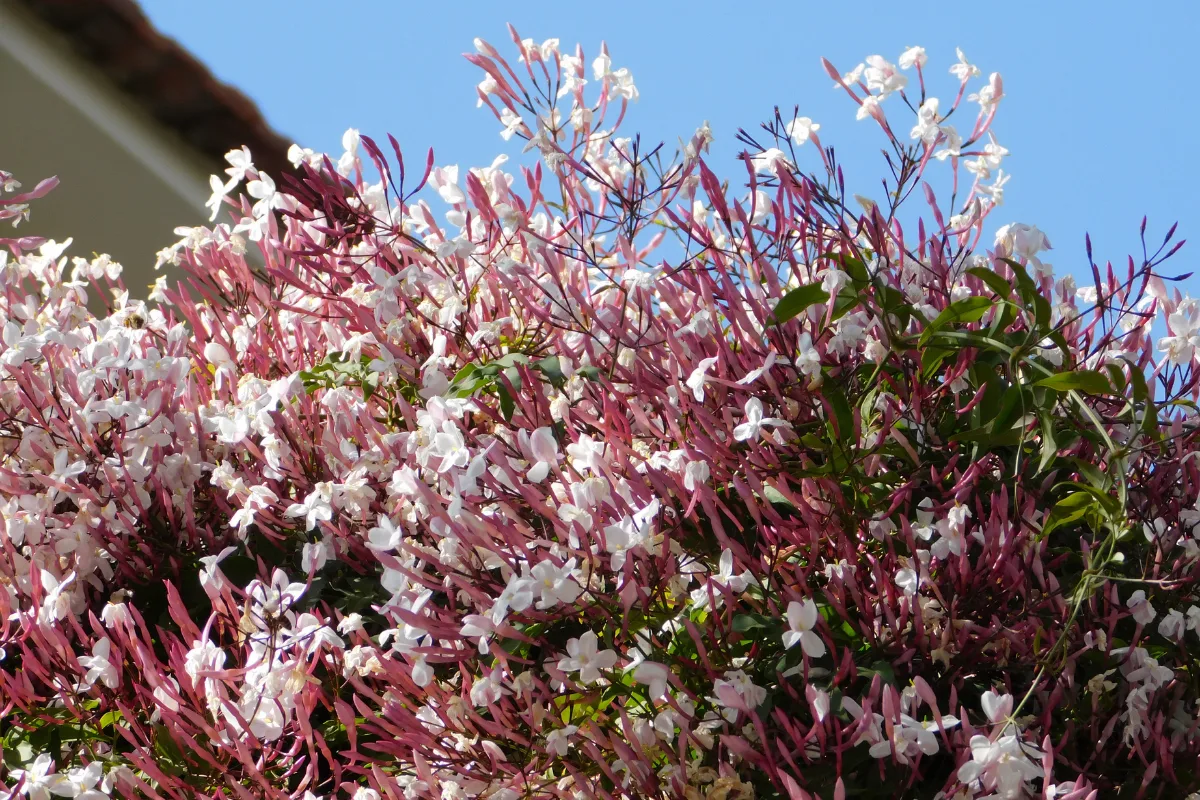
Pink jasmine is a fast twining climber with strongly scented white flowers opening from pink buds. It can cover a trellis quickly and flowers heavily in mild to warm weather, making it useful where you want fragrance as well as dense seasonal cover.
- Grows well in
- Subtropical, Temperate, Cool / mountains, Mediterranean
- Lifecycle
- Evergreen to semi-evergreen perennial climber
- Light
- Full sun, Part shade
- Mature size
- Commonly 4–8 m long, sometimes around 10 m
- Spacing
- About 1.5–3 m between plants
- Growth habit
- Vigorous twining climber
- Native range
- Southern China
- Natural habitat
- Subtropical mountain forest and woodland margins, where it grows as a twining climber.
When to plant
Subtropical
March–May
Temperate
March–May
Cool / mountain
September–November
Mediterranean
March–May
Plant in autumn or spring in mild districts; in cold areas, wait until severe frost has passed.
Planting
Plant beside a strong trellis, fence or pergola where you can keep growth within reach. Set the root ball at its existing depth and tie young stems loosely to the support.
Position and light
Full sun to part shade. Good light encourages flowering; afternoon protection helps in hotter districts.
Soil
Fertile, well-drained soil with organic matter. Avoid low spots that stay saturated after rain.
Watering
Water regularly while establishing, then water deeply when the root zone begins to dry. Keep moisture more even while buds and flowers are developing, particularly on warm walls or fences where the soil can dry quickly.
Feeding
Top-dress with compost in spring and use a light balanced flowering-plant fertiliser if growth is weak. Avoid heavy feeding that produces long soft runners at the expense of a manageable framework.
Pruning
Prune after the main flowering display. Shorten long runners, remove tangled or dead growth and keep the vine off trees and unmanaged vegetation. Because much of the next display comes from established growth, heavy pruning just before flowering can remove buds.
Propagation
Softwood or semi-hardwood cuttings root readily during active growth, and flexible stems can also be layered while still attached to the parent plant. Use propagation from a known plant when you want to keep the same flowering habit.
Common problems
Scale, mealybugs and aphids can gather on dense or stressed growth. Tangled vines reduce airflow and make it harder to check the leaves, so thin old stems when needed. Poor flowering is often linked with deep shade or pruning at the wrong time.
Safety notes
Dispose of prunings where stem pieces cannot take root.
Worth knowing
This is not star jasmine (Trachelospermum jasminoides), which is a different climber with a similar scent. Pink jasmine flowers mainly on the previous season's growth, so prune after flowering if you want to protect the next display.
Grow Pink jasmine with Brancho
Add it to My Garden and Brancho works out what it needs next, timed for your climate.
How it grows around Australia
Growing this too? Share what you've noticed in your garden.
Grow a Little Wild
New plants to try, useful growing tips and a few garden jobs based on what you grow.