
Plant profile
Ashwagandha
Withania somnifera
Also known as Indian ginseng, Winter cherry.
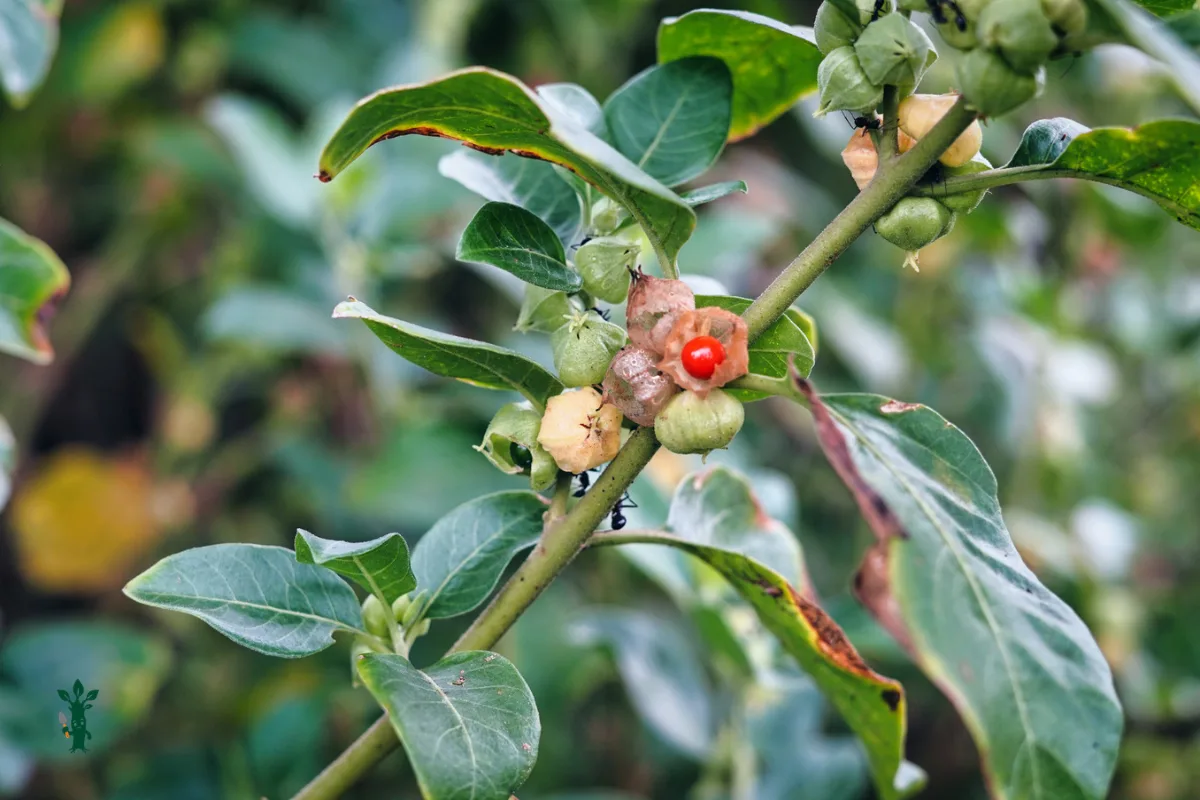
Ashwagandha is a bushy herb from the same plant family as tomatoes. It grows well through warm weather, with small greenish flowers followed by bright orange-red berries tucked inside papery husks. The roots have a long history in traditional Ayurvedic medicine. It's an interesting plant to grow from seed in a sunny bed with good drainage.
- Grows well in
- Tropical, Subtropical, Temperate, Arid / inland, Mediterranean
- Lifecycle
- Short-lived perennial shrub, often grown as an annual
- Light
- Full sun, Part shade
- Mature size
- Usually about 30–100 cm high and 30–75 cm wide in cultivation.
- Spacing
- Allow roughly 40–60 cm between plants.
- Growth habit
- Branching woody-based herb or small shrub with dull green leaves, small greenish flowers and orange-red berries enclosed by papery calyces.
- Native range
- Broad Old World range from northern and eastern Africa and the Mediterranean through western and southern Asia.
- Natural habitat
- Dry open ground, scrub, disturbed places and seasonally dry habitats across its broad native range.
When to plant
Sow after frost risk when soil has warmed. In subtropical districts, spring is straightforward; in very hot dry areas, time establishment so young plants are not facing peak heat immediately after germination.
Planting
Sow or transplant into a warm sunny bed after cold conditions have passed. Space plants so air can move around the branching stems. In climates with cold winters it is simpler to grow as a warm-season annual, while frost-free districts may keep plants longer.
Position and light
Full sun gives compact growth and the best flowering and fruiting. Light part shade is tolerated in very hot climates but usually produces a looser plant. Avoid deeply shaded positions.
Soil
Use free-draining soil. Ashwagandha grows in sandy and relatively lean ground and does not require a heavily enriched vegetable bed. On rich soil, avoid adding large amounts of nitrogen. Raised planting is useful where heavy soil stays saturated after rain.
Watering
Keep seed beds and young transplants evenly moist until established. Mature plants handle some soil drying between waterings. Water deeply rather than giving frequent shallow splashes, and reduce watering when temperatures fall and growth slows.
Feeding
Little feeding is normally required. Compost before planting is enough in many gardens. If growth is poor in very low-fertility soil, use a light balanced feed. Avoid pushing lush soft growth with repeated nitrogen fertiliser.
Pruning
Pinch young plants only if you want a bushier shape. Remove damaged or crowded stems as needed. At the end of an annual crop, remove plants before mature berries scatter if you do not want volunteer seedlings.
Harvest
The roots are usually harvested when the plant matures, often around five to six months after sowing as the leaves start yellowing. Traditionally they are cleaned, cut into pieces and dried before being used in powders or decoctions. This explains how the plant has been used, rather than giving a homemade medicinal dose: the strength of the active compounds varies between plant parts and preparations. The orange berries are for seed saving, not for snacking.
Propagation
Usually propagated from seed. Sow into warm soil and keep lightly moist through germination. Transplant seedlings carefully once they are sturdy enough to handle. Seed collected from healthy mature fruit can be stored dry, but check local weed considerations before distributing seed.
Common problems
Hot, sheltered plants may have spider mites or other sap-feeding insects on the leaves, leaving them pale or speckled. Check underneath the foliage and improve airflow. Roots can deteriorate when soil stays saturated. Ashwagandha can share some soil-borne diseases with tomatoes and eggplants, so rotate the bed with crops from other plant families.
Safety notes
The roots have a genuine history of medicinal use, but a home-grown preparation has no reliable standard dose: active compounds vary by plant part, drying and extraction method. Australia's Therapeutic Goods Administration has reported possible liver injury in very rare cases and gastrointestinal reactions from ashwagandha preparations. It can also interact with medicines and may be unsuitable during pregnancy, breastfeeding or for people with certain health conditions, including thyroid or autoimmune disorders. Check with a qualified health professional before using it medicinally, and keep berries and preparations away from children and pets. Read the TGA's 7 July 2026 safety update: https://www.tga.gov.au/news/safety-updates/withania-somnifera-ashwagandha-and-very-rare-risk-liver-injury
Worth knowing
Ashwagandha is also called Indian ginseng, although it is not related to true ginseng. The part most commonly used in traditional herbal preparations is the root, not the orange berries. You can leave berries on the plant to ripen if you want to save seed for another growing season. Like tomatoes and eggplants, it belongs to the nightshade family, so rotate it with unrelated crops.
Grow Ashwagandha with Brancho
Add it to My Garden and Brancho works out what it needs next, timed for your climate.
How it grows around Australia
Growing this too? Share what you've noticed in your garden.
Grow a Little Wild
New plants to try, useful growing tips and a few garden jobs based on what you grow.