
Plant profile
Calliandra tweediei
Calliandra tweediei
Also known as Calliandra tweedii, Mexican flame bush, Red powderpuff, Red tassel flower.
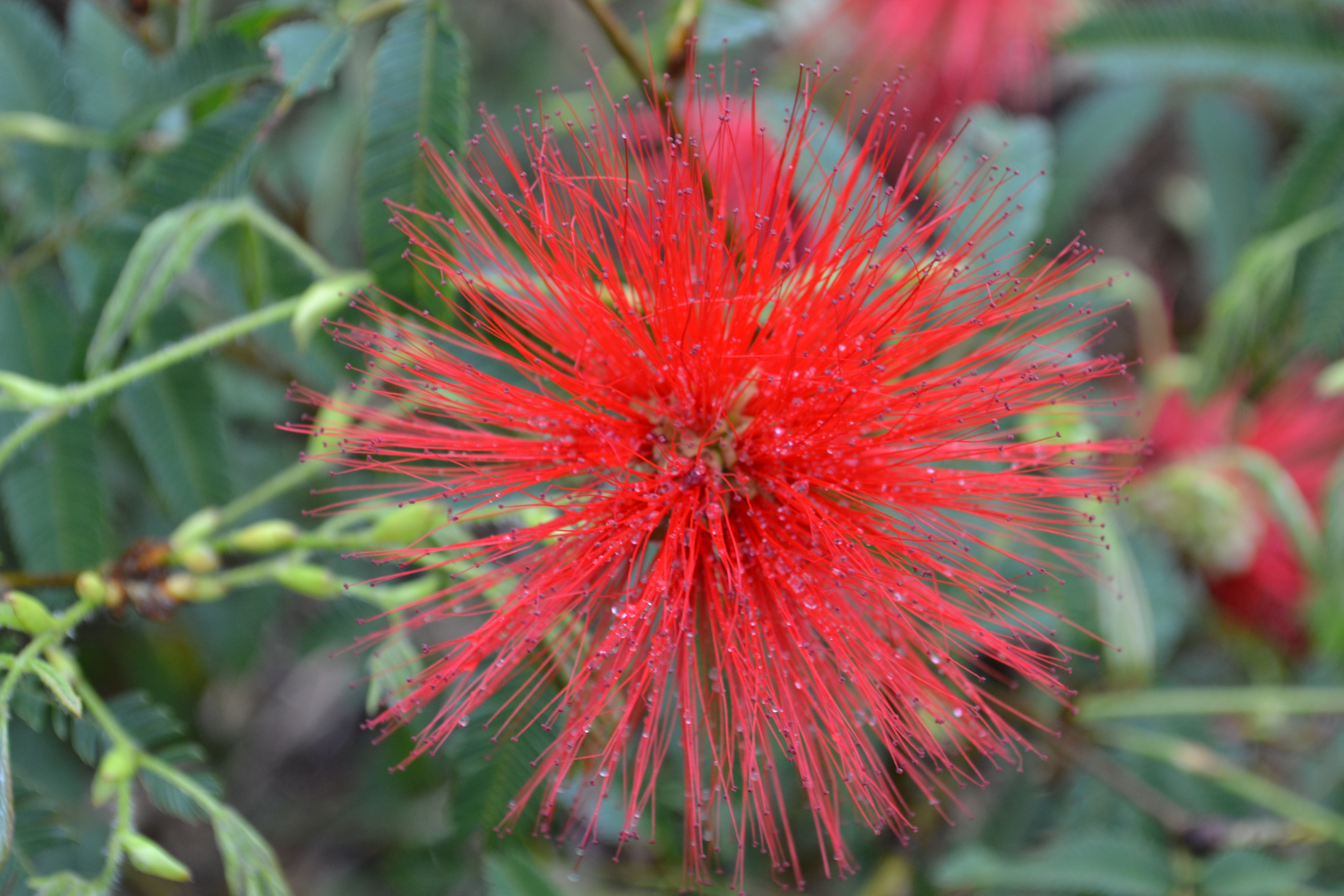
Calliandra tweediei is a spreading warm-climate shrub with fine divided foliage and bright red powder-puff flowers. It can flower for long periods and responds well to pruning when size needs controlling.
- Grows well in
- Tropical, Subtropical, Temperate
- Lifecycle
- Evergreen to semi-evergreen flowering shrub
- Light
- Full sun, Part shade
- Mature size
- Usually around 1.5–3 m high with a broad spreading habit, depending on pruning and climate.
- Spacing
- Allow roughly 2–3 m for an unmanaged shrub.
- Growth habit
- Broad, cane-forming shrub with fine bipinnate leaves and red powder-puff flowers.
- Native range
- Southern Bolivia to south-eastern and southern Brazil and northern Uruguay, including north-eastern Argentina and Paraguay.
- Natural habitat
- Subtropical woodland, forest margins and riverine scrub.
When to plant
Plant during warm weather when regular watering is available. In cooler districts, wait until frost risk has passed.
Planting
Plant in sun to light shade with enough room for the shrub to broaden naturally. Water regularly while it establishes, then deep watering during dry weather is usually enough.
Position and light
Full sun to part shade. Strong light gives the best flowering.
Soil
Moist, free-draining soil suits it best, but established shrubs cope with some dry weather.
Watering
Water regularly while establishing. Mature shrubs are reasonably hardy once rooted.
Feeding
Usually little is needed. Compost or a light balanced feed can be used if flowering or growth is weak.
Pruning
Prune after flowering or whenever long canes move beyond their space. It tolerates hard pruning and can also spread from basal or rooted growth.
Propagation
Stem cuttings are reliable and seed is also possible. Cuttings are the simplest way to copy a plant with the flower colour and habit you like.
Common problems
Dense shrubs flower less if they are clipped constantly. Scale and other sap-sucking insects may also appear on crowded growth.
Worth knowing
The accepted spelling is Calliandra tweediei. The name Calliandra tweedii is still very common in Australian horticulture. Gardening Australia featured C. tweediei as a dependable subtropical Brisbane shrub in 2026. The red flower heads are rich in nectar and are visited by honeyeaters and insects. Where the shrub is retained, letting some flowering growth develop rather than clipping it continuously gives wildlife more use from the plant and makes the display much better.
Grow Calliandra tweediei with Brancho
Add it to My Garden and Brancho works out what it needs next, timed for your climate.
How it grows around Australia
Growing this too? Share what you've noticed in your garden.
Grow a Little Wild
New plants to try, useful growing tips and a few garden jobs based on what you grow.