Plant profile
Custard apple (Atemoya)
Annona × atemoya
Also known as Atemoya, Custard apple.
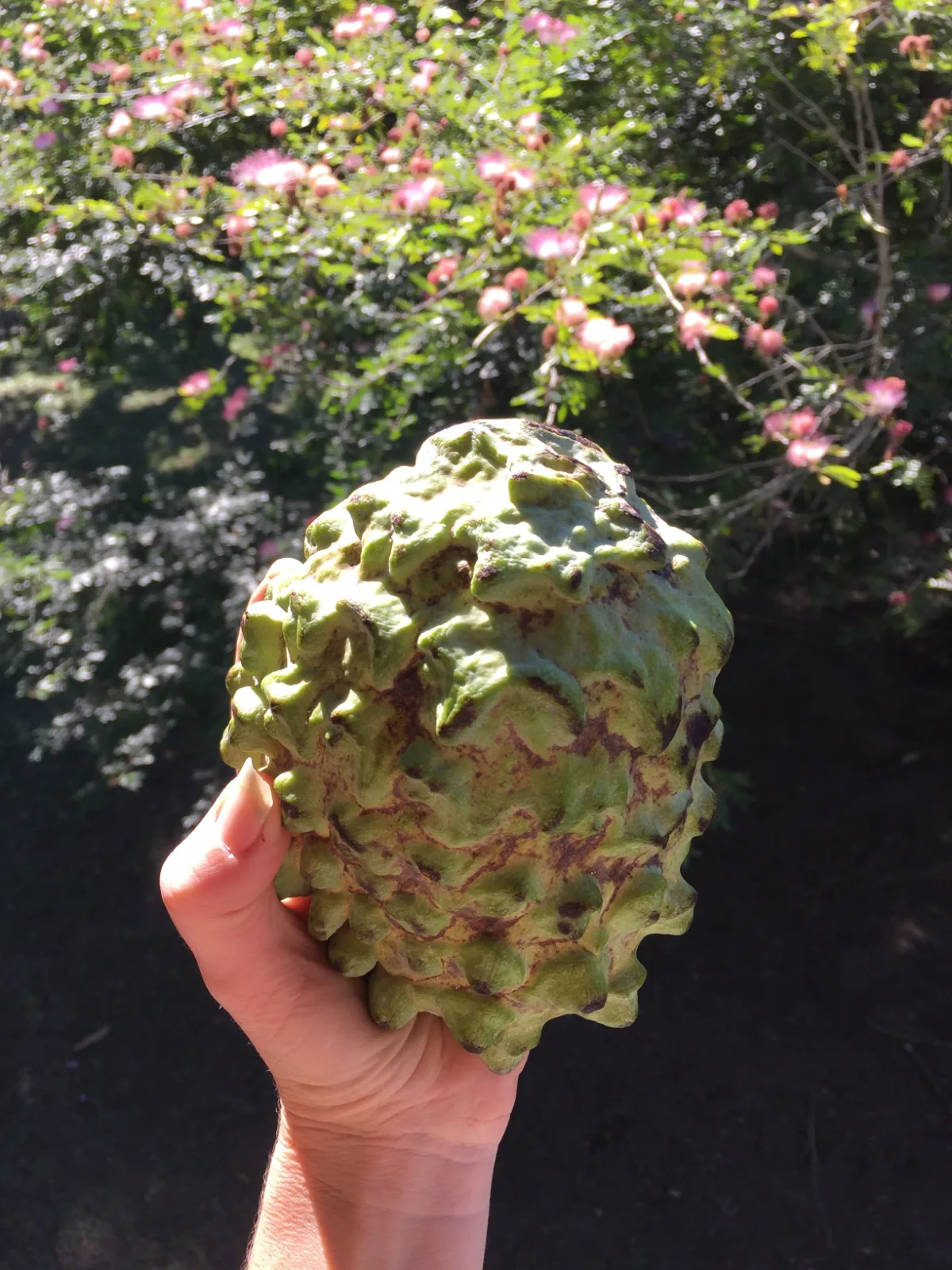
Atemoya is the custard apple most commonly grown in warm Australian orchards: a hybrid with knobbly green fruit, creamy sweet flesh and a strong subtropical pedigree. It is a very good backyard fruit tree where summers are warm, winters are mild and you are happy to give it some pruning and, if needed, a hand with pollination.
- Grows well in
- Tropical, Subtropical
- Lifecycle
- Semi-deciduous to evergreen subtropical fruit tree
- Light
- Full sun
- Mature size
- Usually kept about 3–5 m high and wide in gardens; can grow larger without pruning
- Spacing
- Allow about 4–6 m between backyard trees, depending on pruning and cultivar
- Growth habit
- Branching small to medium fruit tree with a spreading canopy and fruit on new-season growth
- Native range
- Cultivated artificial hybrid; no natural native range. Parent species are Annona cherimola and Annona squamosa.
- Natural habitat
- No natural habitat because atemoya is an artificial hybrid. Its parents come from tropical and subtropical American environments.
When to plant
Subtropical: plant in spring or early summer once the soil is warm. Tropical: plant in a warm period with reliable moisture, avoiding sites that stay wet through prolonged rain. Protect young trees from frost.
Planting
Plant a grafted named cultivar into warm, free-draining ground with room for a broad canopy. Keep the graft union above soil level and mulch the root zone without piling mulch against the trunk. Young trees establish quickly in warm weather, but shelter them from strong wind and protect them from frost in marginal districts.
Position and light
Full sun gives the strongest flowering and fruiting. Good light through the canopy also helps fruit quality, so avoid squeezing the tree between buildings or under taller trees.
Soil
Atemoya grows in a range of soils if drainage is good. Deep sandy loam or loam is ideal, but the main rule is to avoid ground that stays saturated after heavy rain. On heavy soil, improve drainage across the root zone or plant on a broad mound rather than creating a small amended planting hole.
Watering
Water regularly while young and keep moisture reasonably steady from flowering through fruit development. Drought during fruit set can reduce fruit size and cause leaf drop. Ease irrigation when growth slows in the cooler part of the year and do not keep dormant or semi-dormant roots constantly wet.
Feeding
Use compost and a modest balanced fruit-tree fertiliser during active growth. Avoid pushing the tree with heavy nitrogen, which can create a lot of leafy growth without improving fruit set. Split lighter feeds through the warm growing period rather than applying one large dose.
Pruning
Prune to keep a low, open framework and fruit within reach. Atemoya responds well to annual size control as new growth begins, and shortening some of the previous season's growth encourages fresh fruiting shoots. Remove crossing, damaged and crowded branches rather than letting the centre become dense.
Harvest
Harvest when the fruit has filled out and the raised segments begin to flatten and separate slightly. Fruit picked mature will soften indoors over the next few days. Handle it gently because ripe custard apples bruise easily and the skin marks quickly.
Propagation
Named trees are usually grafted so fruit quality and cropping behaviour stay predictable. Seedlings are variable and do not reliably reproduce the parent cultivar. Atemoya can also be propagated by budding or grafting onto compatible Annona rootstocks.
Common problems
Poor fruit set is common when flowers are not pollinated well. Hand pollination can make a large difference on cultivars that set poorly on their own. Mealybugs, scale and fruit fly can also be troublesome, and fruit may split after sharp changes in moisture close to maturity.
Safety notes
Eat the ripe flesh and discard the seeds. Annona seeds are not food and should not be chewed or eaten.
Worth knowing
In Australia, "custard apple" often means atemoya rather than cherimoya or sugar apple. Atemoya is the deliberate hybrid Annona cherimola × A. squamosa. Named cultivars differ in fruit shape, seediness and how readily they set without hand pollination, so keeping the cultivar name is useful.
Featured In
Grow Custard apple (Atemoya) with Brancho
Add it to My Garden and Brancho works out what it needs next, timed for your climate.
How it grows around Australia
Growing this too? Share what you've noticed in your garden.
Grow a Little Wild
New plants to try, useful growing tips and a few garden jobs based on what you grow.