
Plant profile
Flannel flower
Actinotus helianthi Labill.
Also known as Flannel flower, Sydney flannel flower.
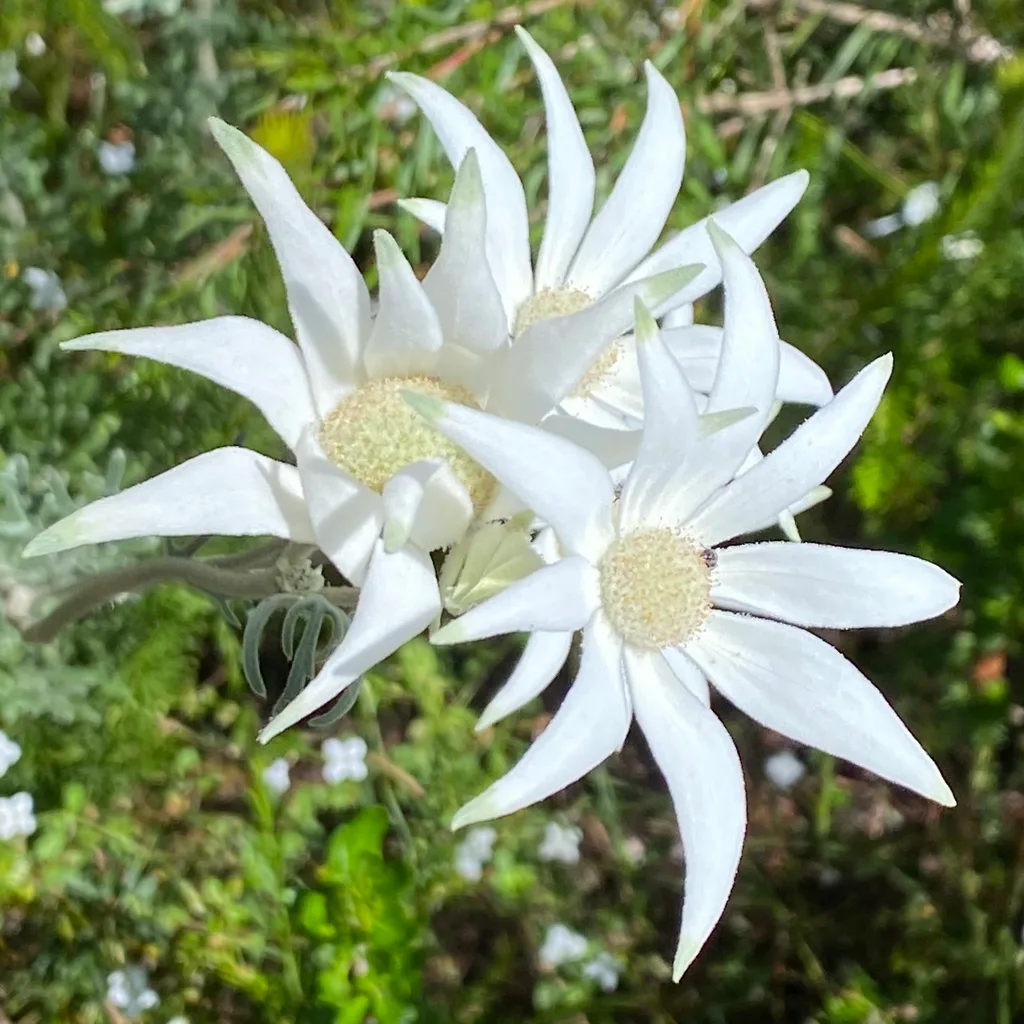
Flannel flowers have beautiful, soft white star-shaped heads and silvery leaves. Grow a few in a sunny sandy bed or big pot for gorgeous spring flowers. They're lovely for cutting, and native bees, hoverflies and beetles visit the tiny flowers in their centres.
 By Elle · Published
- Grows well in
- Temperate, Subtropical, Mediterranean
- Lifecycle
- Annual or perennial; crops productive for about 2 years
- Light
- Full sun, Part shade
- Mature size
- Usually 30–90 cm tall, occasionally up to 1.5 m
- Spacing
- Allow around 50–100 cm between plants
- Growth habit
- Upright, shallow-rooted herb or soft-wooded shrub with woolly grey-green leaves and branching flower stems.
- Native range
- Native to New South Wales and Queensland, including sandstone country on the NSW coast and ranges and areas of central and south-eastern Queensland.
- Natural habitat
- Sandy coastal heath, sandstone ridges, rocky slopes and open eucalypt woodland. Flowering peaks in spring, especially September to November, and can be spectacular after bushfire.
When to plant
Subtropical
March–May
Temperate
March–May
Mediterranean
March–May
Planting
Flannel flowers look beautiful planted in groups through a sunny native garden, rockery or large pot. Leave around 50 cm to 1 m between plants so their flowering stems have room to spread. Plant in autumn in mild districts, or spring after the last heavy frosts. Ease the plant from its pot with the root ball intact and plant at the same depth. Flannel flowers have shallow, delicate roots, so handle them gently during planting. If your garden soil is heavy clay, make a broad raised bed with a free-draining native planting mix. A large pot also works well, particularly for compact selections like 'Starbright'.
Position and light
Grow flannel flowers in full sun for the biggest spring display. They also flower in part shade, especially on woodland edges where sunlight filters through open shrubs. The stems are fairly brittle, so give them some shelter from strong winds. They tolerate light frost once established. In warm, humid parts of Australia, an open, sunny position with good airflow helps the hairy leaves dry after rain.
Soil
Flannel flowers love sandy, slightly acidic soil. A pH around 5.5–6.5 suits them well, and they also grow naturally in shallow pockets of sandy soil among sandstone rocks. For a raised bed, use coarse sand with a free-draining native planting mix. A premium native potting mix works well for container plants. Add mulch around the root area, keeping it clear of the stems. Their shallow roots benefit from having the soil surface protected.
Watering
Water newly planted flannel flowers regularly while their roots establish. After that, they can handle quite dry weather, although a deep drink during a long hot spell will help them keep flowering. There's a handy clue when they're getting thirsty: the leaves start folding in against the stems, before the plant wilts. Water around the base to keep the soft, hairy foliage dry. Check potted plants more often during hot weather.
Feeding
Flannel flowers respond beautifully to feeding. At the Australian Botanic Garden at Mount Annan, growers use a low-phosphorus slow-release fertiliser with trace elements when planting, followed by a liquid feed once a month during active growth. A similar routine is useful in home gardens, particularly if you're growing plants for cut flowers. Use a fertiliser labelled for Australian natives and follow the rate on the packet.
Pruning
After the main spring flowering display, trim the leafy tips to encourage branching and another good flush of flowers. Keep your cuts above healthy green growth, because the old woody stems generally won't reshoot. You can remove old yellow leaves from the lower stems during cooler weather. This helps air move through the plant, especially in humid gardens.

Practical uses
Cut flowers: Those velvety white flowerheads look beautiful in bouquets, especially with other Australian wildflowers. The silvery leaves and slender stems make lovely additions to small arrangements.
Pots and raised beds: Grow compact selections like 'Starbright' in a wide pot, or plant several flannel flowers together in a raised garden bed.
Rockeries and native borders: Flannel flowers are lovely among sandstone rocks, low shrubs and open patches of native garden. Their white flowerheads stand out beautifully against the grey-green leaves.
Pressed flowers: Pick the flowerheads before they form seed and press them for cards or botanical crafts.

Permaculture uses
Flannel flowers make a lovely addition to a permaculture insectary. Adult common hoverflies and native bees visit the flowers, and hoverfly larvae feed on aphids.
Grow a group along a sunny, well-drained edge of your veggie garden, mixed with other flowering plants that provide nectar and pollen at different times of year.

Wildlife and pollinators
Native bees, hoverflies, beetles and butterflies visit the tiny flowers in the centre of each flannel flowerhead.
Native bees: Little reed bees (Exoneura bicolor) visit the flowers. Ecologist Nathan Emery documented them at Manly-Warringah War Memorial Park in Sydney, along with introduced honeybees. In his fieldwork, bees visited about three times as many flowerheads per plant as the other insect groups.
In the Blue Mountains, native plant enthusiast Michelle de Mol photographed a male yellow-green Austral-Nomia bee (Lipotriches flavoviridis) pollinating a flannel flower. It's a lovely close-up of a native bee at work.
Hoverflies: The common hoverfly (Ischiodon scutellaris) visits the little flowers too. Adults feed at flowers, while their larvae eat aphids. Emery recorded the species among his flannel-flower visitors, along with other flies.
Beetles: Tiny pintail beetles in the genera Mordella and Tomoxioda move across the flowerheads. Native jewel beetles, including Neocuris gracilis and N. guerinii, have also been recorded on flannel flowers in Australia.
Butterflies: Michelle de Mol also photographed a caper white butterfly (Belenois java) drinking nectar from a flannel flower in the Blue Mountains. You can see her bee and butterfly photographs in the Australian Plants Society collection.
Flies have an interesting part in the plant's reproduction too. Emery found that increased fly visitation was linked with better seed production in the populations he studied.
Harvest
Flannel flowers make gorgeous cut flowers! Pick the stems when the tiny flowers in the centre are just beginning to open, then put the cut ends straight into water. Air can enter the cut stems and shorten their vase life if they're left lying around. In cut-flower trials, Cathy Offord and Joanne Tyler found that one selected flannel flower lasted nearly two weeks in a vase. Their plants could produce another flush after stems were picked, too. For pressed or dried flowers, harvest the white flowerheads before the little central flowers start forming seed.
Propagation
Flannel flower seed can take some patience. Freshly collected seeds may be dormant, and Lynette Lee and Peter Goodwin at the University of Sydney found that some seed germinated better after 2–12 months of dry storage. Temperatures around 15–20°C gave the best results in their trials. Collect the fluffy seedheads as they ripen and sow into individual tubes or small pots of free-draining seed mix. You'll be able to plant out the seedlings with less disturbance to their delicate roots. A commercial smoke-water treatment can help some seed lots germinate, so follow the product directions if you're trying it. For cuttings, take 7.5–10 cm pieces of firm growth in late summer. Put them in free-draining propagation mix, protect them from hot afternoon sun and avoid constant overhead misting on the hairy foliage.
Common problems
Grey mould or brown stems: Flannel flowers can develop Botrytis during humid weather. Remove affected growth, give the plants more airflow and water around their roots. Wilting or collapsing plants: Root diseases involving Fusarium, Pythium or Phytophthora can occur, especially in poorly drained soil. Check the root zone and drainage before giving a wilted plant more water. Chewed leaves: Caterpillars sometimes feed on the foliage. Look for holes and the small droppings they leave behind so you can identify what's visiting. Aphids, scale and mealybugs: These can gather on new shoots and around crowded stems. For small infestations, remove affected tips or wipe the insects off gently.
Safety notes
The fine hairs on flannel flower stems and leaves can irritate some people's skin or airways, particularly when handling lots of cut stems. Wear gloves if the foliage irritates your skin.
Worth knowing
Flannel flowers belong to the carrot family (Apiaceae), along with parsley and celery. Those gorgeous soft white 'petals' are bracts surrounding a cluster of tiny flowers. The true flowers have no petals at all.
Companion and understory planting
Flannel flowers look gorgeous in a sandstone-heath garden with fuchsia heath (Epacris longiflora), mountain devil (Lambertia formosa) and heath-leaved banksia (Banksia ericifolia). All four grow within the eastern suburbs banksia scrub plant community around Sydney.
Try flannel flowers in the sunny openings, with the larger shrubs farther back. You'll get the soft white spring flowers near the front, with pink heath flowers and the striking red blooms of mountain devil adding colour around them.
In a smaller garden, low native daisies and little grasses make lovely neighbours. Leave an open spot for the flannel flowers so their shallow roots aren't crowded.
Tradition and history
Flannel flowers are part of Yaegl seasonal knowledge on the north coast of New South Wales. Their flowering in September traditionally marked the time when shellfish and crabs were at their best for eating. The pale flesh of these foods was compared with the white flannel flower, according to Maclean Landcare Group's account of the Yaegl seasonal calendar.
Flannel flowers have a more recent place in Australian history too. For the Centenary of Federation in 2001, New South Wales chose the flannel flower selection 'Federation Stars' as its Federation flower. The Australian Botanic Garden at Mount Annan helped develop flannel flowers for gardens and cut-flower growers.
Growth and roots
Flannel flowers usually grow 30–90 cm tall, although some reach 1.5 m. Their roots are shallow and easily disturbed, and the upright flowering stems can break in strong winds. Queensland cut-flower growers commonly allow about two productive years for a crop.
They grow beautifully in sunny beds beside paths and low walls, or in large pots near a pool. Give the flower stems a little room away from busy paths and avoid digging around established roots.
References
- NSW PlantNET — Actinotus helianthi taxonomy, range and flowering
- Botanic Gardens of Sydney — Growing Flannel Flowers
- Australian National Botanic Gardens — Actinotus helianthi
- Australian Native Plants Society — Actinotus helianthi
- Dr Nathan Emery — On the seed biology of the Sydney flannel flower, Australian Plants 28(227), 2016
- Michelle de Mol — Insects that thrive on our native plants, Australian Plants Society
- Bellamy et al. (2013) — Neocuris host flower records, Insecta Mundi 0293
- NSW Environment — Eastern suburbs banksia scrub native plant community
- Cathy Offord and Joanne Tyler — Flannel Flowers as Cut Flowers (ANPSA reprint)
- Queensland DPI — Should I Grow Wildflowers? Flannel flower species production
- Maclean Landcare Group — Flannel flower: Yaegl seasonal knowledge (2014)
- Australian National Botanic Gardens — Federation flora
- VicFlora — Actinotus helianthi naturalised in Victoria
- Weeds of Australia — Actinotus helianthi naturalised distribution
- University of Botanic Gardens Trust — Fertiliser effect on Actinotus helianthi in pots (2006)
- Australian Plants Society — Flannel Flower at North Head, Ian Cox garden, Carnarvon and Isla Gorge
- Lynette A. Lee and Peter B. Goodwin (2006) — Development, Germination and Dormancy of Actinotus helianthi Seeds, Australian Flora Foundation
- Horticultural Flora of South-eastern Australia — Actinotus helianthi; flowers lacking petals with surrounding bracts, Apiaceae
Featured In
Grow Flannel flower with Brancho
Add it to My Garden and Brancho works out what it needs next, timed for your climate.
How it grows around Australia
Growing this too? Share what you've noticed in your garden.
Updates appear in My Brancho. Email alerts are not available yet.
Grow a Little Wild
New plants to try, useful growing tips and a few garden jobs based on what you grow.