



Plant profile
Longevity Spinach
Gynura procumbens (Lour.) Merr.
Also known as Longevity greens, Sambung nyawa.
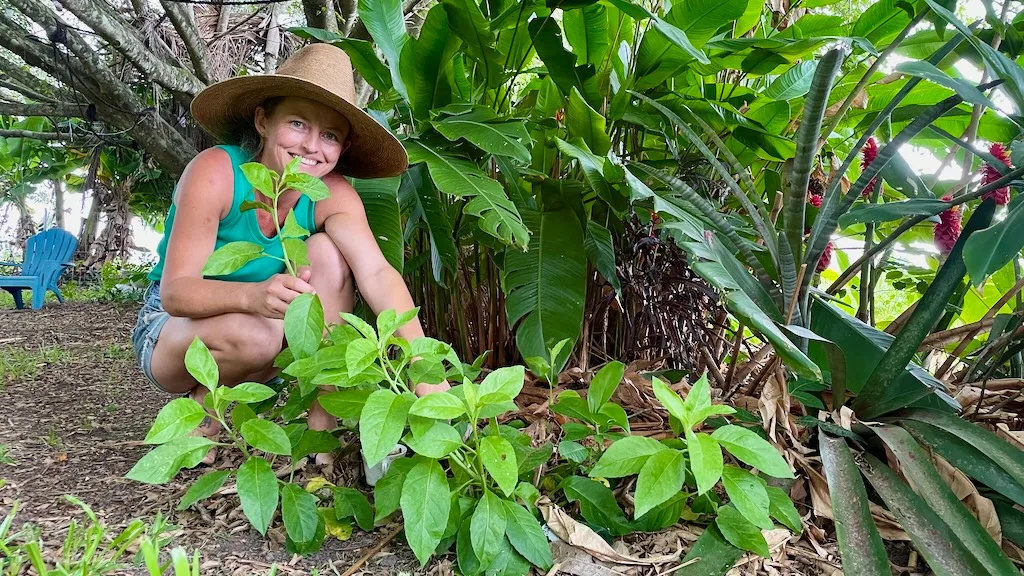
Longevity spinach is a fast-growing edible perennial that spreads into a thick groundcover under taller plants. You can harvest the leaves for food and cut the soft stems for mulch or compost. Researchers have even tested it in chicken and livestock feed. I've been growing Sambung for years. Mine has spread about three metres across, and the chickens love it so much I can hardly keep them out!
 By Elle · Published
- Grows well in
- Tropical, Subtropical, Temperate
- Lifecycle
- Perennial leafy green
- Light
- Shade, Part shade, Full sun
- Mature size
- Low and spreading when used as a groundcover; stems can scramble through surrounding plants and spread for several metres. My North Queensland patch is about 3 m across.
- Spacing
- About 45–60 cm apart.
- Growth habit
- Soft-stemmed perennial that sprawls and scrambles through surrounding plants. Stems can develop roots at nodes where they stay in contact with the soil, gradually forming a dense patch.
- Native range
- Tropical Africa, southern and southeastern Asia, and New Guinea.
- Natural habitat
- Forest-stream margins, thickets and sandy slopes within its native range.
When to plant
Tropical
January–December
Subtropical
September–May
Temperate
October–March
Planting
Plant rooted cuttings into moist, well-draining soil with plenty of organic matter. Set the root ball at the same depth it was growing in the pot, water it in well and add mulch around the soil. Keep new plants watered while their roots establish. In hot climates, shade or part shade makes establishment easier. In cooler areas, wait until frost has passed and choose a warm, sheltered spot.
Position and light
Longevity spinach loves a warm, humid climate and grows beautifully in tropical and subtropical gardens. It prefers a bit of shade, although it can handle some direct sun if there's enough moisture in the soil. Mine grows among heliconias and other plants, where it gets plenty of shade. You can also grow Longevity spinach in cooler parts of Australia if you give it a warm, protected position. Frost can damage the soft leaves and stems. If you live somewhere with cold winters, try growing it in a pot so you can move it somewhere warmer when you need to.
Soil
Plant Longevity spinach in well-draining soil with plenty of organic matter. Add a nice layer of compost if your soil needs improving, then mulch around the plants to help hold moisture. Mine gets through the wet season without any trouble, despite growing in a spot that can get pretty boggy. Still, I'd try and avoid planting Sambung in soil that stays really wet, especially while it's young.
Watering
Keep your newly planted Longevity spinach watered while its roots establish. Once it's growing well, it can cope with less frequent watering. I've found mine handles dry weather much better than I expected! Even when the plants around it are struggling with the lack of rain, my Sambung keeps growing quite happily.
Feeding
I don't actually fertilise my Longevity spinach, and it grows beautifully without it. But if you want to encourage plenty of fresh leaves for harvesting, you can add some compost or well-rotted manure around the plants every now and then. I like to use the big leaves from the heliconias and galangal growing around my Sambung as mulch. They're fantastic for chop-and-drop mulching, helping to hold moisture in the soil and keep the weeds down. As the leaves break down, they also add organic matter to the soil. You can use worm castings too, or give your Longevity spinach a bit of liquid fertiliser if you want to.
Pruning
Cut your plants back whenever the stems start growing further than you want them to. Use clean scissors or secateurs to cut stems just above a pair of leaves. New shoots can grow from the nodes below the cut, which helps the plant grow bushier. If you leave the stems to grow long, it can get a bit leggy. Your chopped stems can go into your compost or you can use them as mulch. Healthy pieces are also great for propagation.

Practical uses
Eating Longevity Spinach
In Malaysia, people eat fresh Longevity spinach leaves as ulam, a traditional way of serving fresh herbs and vegetables with rice and other foods. In Thailand, people cook the leaves too.
Stephen Facciola's Cornucopia II: A Source Book of Edible Plants lists Sambung under its older botanical name, Gynura sarmentosa. He reports the leaves being used as a condiment, as well as a vegetable.
The book doesn't explain exactly how the condiment was prepared, but it's an interesting bit of culinary history.
A 2021 Indonesian paper also reports people eating around five to eight Sambung leaves, or roughly 10–16 g, with their daily meals. That's a record of how people use the plant rather than a recommended amount.
Have you ever used Longevity spinach as a condiment or seasoning? I'd love to hear how you prepare it. Let us know in the comments below!

Permaculture uses
An edible groundcover
Longevity spinach is a fantastic edible groundcover. Its long stems can develop roots where they touch the soil, helping it form a thick patch. The leaves shade the ground, and the thick growth helps keep the weeds down.
Ketah Silvester has done something lovely with this in her Brisbane food forest. She grows Sambung alongside Brazilian spinach and other edible groundcovers on a property that was once a dry, weedy hillside.
In her Gardening Australia article, Ketah writes that “Weeds are almost non-existent” thanks to the dense planting. Her garden now has hundreds of edible perennial plants, with fruit trees, climbers and different groundcovers growing together.
Mulch, compost and worm farms
Permaculture grower Ewa Bekiesch uses Longevity spinach for chop-and-drop mulch, compost and feeding the worms in her worm farm.
She cuts leaves and stems from established plants and uses them as mulch around other plants. The soft leaves and stems break down quickly, adding organic matter to the soil.
You can also chop up some Sambung leaves and stems and add them to your worm farm. The worms turn them into worm castings and liquid fertiliser you can use around your garden.
Ewa explains how she uses Sambung in her Food Forest Seeds article.

Wildlife and pollinators
Sambung can grow little orange flowers, although I've never seen mine flower. I'd love to one day, though!
In Bangkok, Hawkeswood and Sommung documented plain tiger butterflies (Danaus chrysippus) drinking nectar from Sambung flowers. In Australia, plain tiger butterflies are uncommon, with records from the Northern Territory and Torres Strait.
Harvest
Harvest Longevity spinach leaves whenever you need them. You can pick individual leaves or cut whole stems if you want a larger harvest for cooking. Regular harvesting also gives the plant a trim and encourages fresh growth.
Propagation
Sambung is easy to grow from cuttings. Cut a stem about 10–15 cm long with three or four nodes. Remove the leaves from the bottom section. You can either put the cutting in a glass of water or plant it in moist potting mix. Keep at least one node below the water or soil, as that's where new roots develop. Keep your cuttings somewhere warm and out of full sun. If you're growing them in water, change the water regularly. If they're in potting mix, keep the soil moist while the roots develop. For cuttings growing in water, wait until they've developed several healthy roots before planting them into potting mix. If you've planted your cuttings directly into potting mix, look for roots appearing through the drainage holes. That's a good sign they're becoming established and may be ready for a bigger pot. You can also use layering to grow more Longevity spinach. Bend a long stem down onto the soil and hold it there with a rock or garden peg. Roots can develop wherever a node touches the soil. You can leave the stems connected and let your Sambung spread, or cut a rooted section away and dig it up if you'd like to move it somewhere else.
Common problems
Young plants can wilt or stall if they dry out before their roots establish, especially in strong sun. Frost can damage the soft leaves and stems, so protect plants in cooler climates. Once established, the main thing to watch is spread. Stems can root wherever they stay in contact with moist soil, so trim them back before they run into plants you want to keep clear. Don't leave live prunings on damp ground if you don't want them to take root.
Safety notes
Longevity spinach has a long history as food as well as traditional medicine, but concentrated medicinal products are a different thing from eating the leaves as food. Researchers found pyrrolizidine alkaloids in some Gynura procumbens plant samples and commercial products, with levels varying widely. Because some pyrrolizidine alkaloids can harm the liver, I'd be cautious with concentrated extracts, supplements or high-dose medicinal use.
Companion and understory planting
A clever Melbourne microclimate
I love what Angelo Eliades has done in his Melbourne permaculture garden!
He's growing Longevity spinach alongside turmeric and a dwarf Cavendish banana in a sheltered garden. He's also used a brick wall and surrounding plants to create a microclimate where he can grow several subtropical plants together.
The banana provides shade for the turmeric, while the brick wall helps hold warmth. Angelo also grows vetiver grass nearby, which he cuts and uses as mulch.
It's a brilliant example of how you can create your own little microclimate and grow subtropical plants in a cooler climate, including Melbourne.
You can see the planting in Angelo's Deep Green Permaculture article.
Other companions
Bananas, turmeric, ginger and heliconias are all interesting plants to grow alongside Sambung. They enjoy similar warm, sheltered conditions, and the taller plants can provide shade for Sambung growing underneath.
Sambung, in turn, helps cover the soil between taller plants. You could also combine it with Brazilian spinach and other edible groundcovers, as Ketah has done in Brisbane.
Livestock and safety
Chickens
My chickens absolutely love Sambung. I've got a big patch growing, and I can hardly keep them out of it!
There's also been some interesting research into Sambung as a poultry feed ingredient.
In a study of 160 laying hens, the chickens that had more Sambung added to their feed laid more eggs. Their eggs also had stronger shells, better yolk colour and less cholesterol in the yolks.
The researchers found that the hens needed less feed for the amount of eggs they laid, too.
That's quite an interesting result for a plant my chickens have already been helping themselves to!
Cattle, goats and sheep
Researchers in Indonesia have also tested fresh Sambung as livestock forage.
Cattle and goats ate most of the Sambung they were offered. Cattle ate both the leaves and soft stems, while goats preferred the leaves. Sheep ate it too, although not as enthusiastically as the cattle and goats.
The leaves were much richer in protein than the stems. In the study, Sambung leaves measured 26.7% crude protein, compared with 7.64% in the edible stems.
Another Indonesian study tested Sambung in the diets of young sheep. The control lambs gained an average of 104.50 g a day. Lambs receiving 5% Sambung gained 90.99 g a day, while those receiving 10% gained 108.11 g a day.
The researchers also recorded fewer Strongyloides parasites and lower methane emissions in the Sambung-fed groups.
I'd avoid feeding Sambung to horses until there's reliable information about its suitability for them.
Tradition and history
A plant with a long medicinal history
The Malay name Sambung nyawa translates as 'prolonging life', which gives you an idea of how highly people have regarded this plant.
In Malaysia, researchers working with Indigenous Orang Asli communities recorded people using fresh Sambung leaves to help control blood glucose levels.
Malaysia's Forest Research Institute also records Sambung being prepared as poultices and boiled extracts. Traditional uses include skin complaints, fevers, kidney problems and diabetes.
Sambung tea and herbal baths
Researchers in the southern Philippines documented the Manobo people's use of Sambung leaves as brewed tea or a decoction for stomach complaints, coughs and kidney stones.
In Indonesia, Universitas Nasional's medicinal plant collection records Sambung leaves being used in herbal baths for rheumatism and paralysis.
These are records of traditional use rather than instructions for treating an illness.
Growth and roots
Longevity spinach has a shallow root system as well as soft stems that can form roots where the nodes sit against moist soil. That means an established patch can spread a long way across the ground without developing the big woody root system you'd expect from a tree or large shrub. Mine is around three metres across.
Based on that shallow, non-woody root habit, I'd consider it low risk for lifting sound paving or damaging a sound wall or pool structure. The stems are more likely to be the nuisance: they'll creep over edges and can root into damp soil beside paths, so trim them back where you want a neat boundary.
I wouldn't grow Longevity spinach over a septic absorption trench. Australian council guidance recommends shallow-rooted groundcovers around these systems, but also says fruit and vegetables shouldn't be planted over the absorption field because of contamination risk. If you're growing it near a septic system, keep the edible patch outside the effluent area.
References
- Gynura procumbens — Plants of the World Online, Kew
- Gynura procumbens — NParks Singapore
- Ketah Silvester Food Forest — Gardening Australia Magazine
- Longevity Spinach / Sambung — Food Forest Seeds & Plants Australia
- Growing Turmeric in Temperate Climates — Deep Green Permaculture
- Sambung propagation — ECHOcommunity
- Plain Tiger butterfly flower visitation to Gynura procumbens
- Gynura procumbens in laying hen feed — PubMed
- Gynura procumbens forage nutrition and palatability study
- Gynura procumbens in sheep feed — IPB University
- Orang Asli ethnobotanical research — Gynura procumbens
- Sambung Nyawa — Forest Research Institute Malaysia
- Manobo ethnobotany — Gynura procumbens
- Gynura procumbens — Universitas Nasional medicinal plant collection
- Gynura procumbens review — Applied Sciences
- Pyrrolizidine alkaloids in Gynura procumbens and products
- Sambung food ethnobotany — Malaysia Biodiversity Information System
- Gynura procumbens overview — PMC
- Cornucopia II: A Source Book of Edible Plants — Stephen Facciola
- Queensland Biosecurity Regulation 2016 — restricted invasive matter
- Australian Government Permitted Seeds List — Gynura procumbens
- Weeds of Western Australia — WA DBCA
- Longevity Spinach — GardeningSG / NParks Singapore
- Onsite wastewater system maintenance — Shire of Toodyay

Grow Longevity Spinach with Brancho
Add it to My Garden and Brancho works out what it needs next, timed for your climate.
How it grows around Australia
Growing this too? Share what you've noticed in your garden.
Updates appear in My Brancho. Email alerts are not available yet.
Grow a Little Wild
New plants to try, useful growing tips and a few garden jobs based on what you grow.