



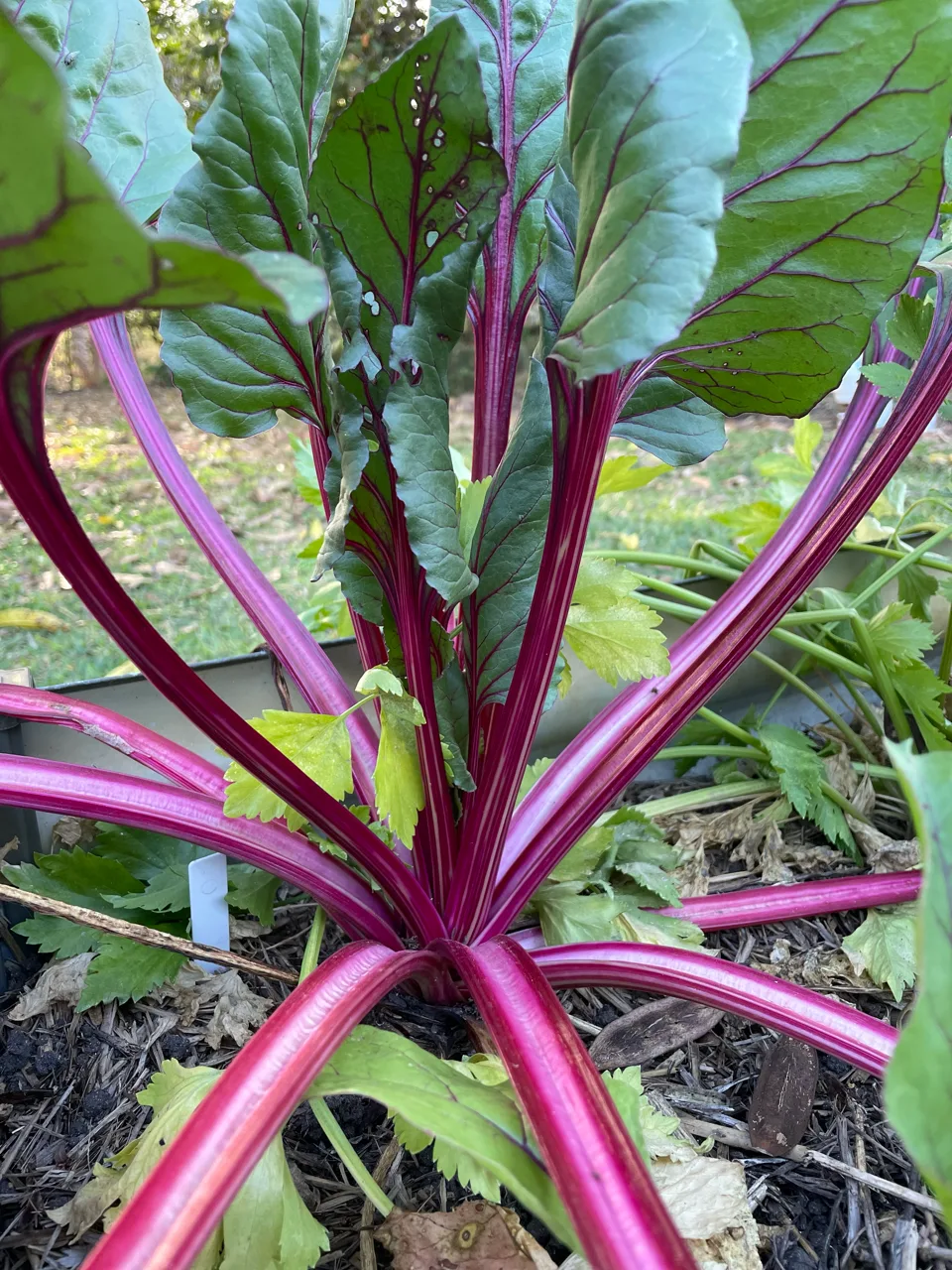
Plant profile
Silverbeet
Beta vulgaris subsp. vulgaris (Cicla Group)
Also known as Swiss chard, chard.
Grow silverbeet for months of delicious leaves, even with some afternoon shade. Pick from the outside and the plant keeps producing, whether you choose big white-stemmed ‘Fordhook Giant’ or bright rainbow chard. It's a beautiful, generous vegetable for pots and garden beds.
 By Elle · Published
- Grows well in
- Tropical, Subtropical, Temperate, Cool / mountains, Arid / inland, Mediterranean
- Lifecycle
- Leafy biennial usually grown as an annual
- Light
- Full sun, Part shade
- Mature size
- Usually 40–75 cm tall and about 30–50 cm wide
- Spacing
- 30–45 cm between full-sized plants
- Growth habit
- Upright leafy biennial, usually grown for one long harvest season
- Native range
- Silverbeet is a cultivated leaf beet descended from wild sea beet of the Atlantic and Mediterranean coasts. Its wild ancestry extends into western Asia.
- Natural habitat
- Cultivated garden vegetable; its wild sea-beet relatives grow on coastal ground, including saline soils.
When to plant
Tropical
April–July
Subtropical
February–October
Temperate
January–May, September–December
Cool / mountain
January–March, September–December
Arid inland
March–May, August–October
Mediterranean
January–April, August–December
In warm northern areas, aim for autumn and winter planting; in frost-prone areas sow after the worst cold has passed. See the planting windows for your climate.
Planting
Sow silverbeet straight into a garden bed, or start it in punnets and transplant while the seedlings are young. In cool areas, spring is the easiest time to start. In the subtropics and tropics, you'll generally get better leaves by planting through the cooler months. Mild districts can grow it across much of the year. Sow the rough, knobbly seed clusters about 5–10 mm deep. Each cluster can produce several seedlings, so thin them down to one strong plant when they're large enough to handle. Give full-sized silverbeet around 30–45 cm between plants. Seeds commonly emerge in about 7–10 days when the soil is warm enough. Silverbeet is a good pot crop too. In Gardening Australia's 'Shady Greens', Tammy Huynh grows one plant in a large container at least 30 cm deep. A quality potting mix and steady watering help it produce plenty of leaves.
Position and light
Silverbeet grows best with plenty of sunshine, but it's a genuinely useful vegetable for part shade. If your garden gets morning sun and afternoon shade, you can still pick a good crop. Deep shade will slow growth and give you fewer leaves. In Perth, Josh Byrne uses simple wire frames with shade covers to protect his summer silverbeet. It's a useful approach for hot Australian gardens. In cooler parts of the country, give your plants the brightest spot you have, especially in winter. Good airflow also helps during humid weather, when leaf spot can spread.
Soil
Give silverbeet fertile soil with plenty of compost and enough depth for its roots. A well-draining loam is excellent, but it will grow in improved clay or sandy soil if you keep up the water and nutrients. A slightly acidic to neutral pH, around 6–7.5, works well. If you have heavy clay that stays wet after rain, grow it in a raised bed. A layer of mulch helps keep the soil moisture more even between waterings.
Watering
Water silverbeet regularly while the plants are growing and you're picking leaves. Give the soil a good soaking, then check it before watering again. If plants repeatedly wilt, the new leaves tend to be smaller and less tender. Pots dry out faster than garden beds, particularly on warm, windy days. Mulch the surface and check containers often. In humid weather, watering the soil instead of the leaves helps reduce the long periods of leaf wetness that favour leaf spot.
Feeding
Mix finished compost into the bed before planting. Silverbeet produces a lot of leaves, so it can use up nutrients quickly during a long harvest season. If new growth becomes smaller or pale, give the plants a light feed with a nitrogen-containing vegetable fertiliser or a suitable liquid feed. A good potting mix with slow-release fertiliser gives container plants a useful start; feed again as needed while you keep harvesting.
Pruning
As you pick silverbeet, remove any damaged or yellowing leaves from the base. If a flower stalk starts coming up, you can cut it off and get a little more leaf growth. Once the plant is flowering strongly, though, the leaves usually become less worthwhile. That's a good time to replace it with a new seedling, unless you're saving seed.

Practical uses
Leaves and stalks: Use baby leaves in salads, or cook larger leaves the way you'd cook spinach. Cut the thick stalks away first if you want to give them a little longer in the pan. The leaves also freeze well after blanching.
A colourful edible border: Rainbow chard has red, pink, orange and yellow stalks, so you can grow it among herbs and flowers as well as in a vegetable bed. If space is tight, a deep pot near the kitchen door works beautifully.

Permaculture uses
A crop you can keep picking: One silverbeet plant can supply multiple harvests of leaves. Sow new plants before the old ones finish, and you can keep a useful patch going over a long season. The large leaves also make a good-looking, productive layer along a sunny or partly shaded vegetable-garden edge.
A real community harvest: At Werribee Mansion in Victoria, Parks Victoria ranger James Brincat helps coordinate a silverbeet project that grew from an idea for a green-manure planting into food relief. The formal parterre has included 3,000–4,000 plants, and Gardening Australia reported about 5,500 kg of food produced through the project. Volunteers harvest the greens and members of the local Sikh community cook them for meals shared with others.

Wildlife and pollinators
Silverbeet is usually harvested before it flowers. When plants are left to set seed, their small flowers are mainly wind-pollinated.
One well-documented insect connection is serpentine leafminer (Liriomyza huidobrensis), whose larvae feed inside silverbeet leaves. They leave pale, winding tracks through the green tissue. Queensland's horticultural biosecurity guidance identifies silverbeet as a host of this leafminer.
Harvest
Pick the largest outside leaves and leave the small ones in the middle to grow. You can start taking baby leaves early, but allow roughly 8–10 weeks for a substantial harvest from a new plant. Both the green leaves and the thick white, yellow or red stalks are edible. At Werribee Mansion in Victoria, volunteer Soo Jin Goh recommends harvesting in the morning and snapping the outer leaves cleanly off near their base. Keeping the middle intact lets the crop keep producing for another round. For the kitchen, cook thick stalks a little longer than the leafy parts, or slice both finely for a quick meal.
Propagation
Silverbeet is easy to grow from seed. The 'seeds' in a packet are usually corky clusters containing several seeds, which explains why a little group of seedlings may appear in one spot. Thin them when they're small or gently move the extras. If you'd like to save your own seed, keep several healthy plants growing into their second season. After cool weather they can send up tall flower stalks. Seed Savers Connect Australia recommends collecting the stalks when the lower seed clusters turn brown, then drying them thoroughly before rubbing the seeds free. Silverbeet and beetroot are wind-pollinated and can cross with one another when they're flowering at the same time. If you want seed that stays true to a particular variety, allow plenty of separation from other flowering beets and chards.
Common problems
Slugs and snails can chew young seedlings, so check newly planted beds in damp weather. Pale, winding trails through the leaves are usually caused by leafminer larvae feeding inside the leaf. Remove badly affected leaves and look at the undersides of new growth for aphids. In warm, wet weather, Cercospora leaf spot can produce little grey centres with reddish-brown borders. Older spots may break through the leaf, leaving holes. Take away affected foliage, keep the plants open to the air and avoid wetting the leaves late in the day. Queensland's horticultural disease guidance also recommends rotating beet crops away from affected beds.
Safety notes
Silverbeet contains a substantial amount of oxalate. If you need to limit oxalates, particularly because of calcium-oxalate kidney stones, boiling the leaves and discarding the cooking water reduces the soluble portion.
Worth knowing
Silverbeet and beetroot are both forms of Beta vulgaris, selected for very different harvests: silverbeet for its leaves and thick stalks, beetroot for its swollen roots. ‘Perpetual spinach’ is another leafy beet type, despite its name.
Companion and understory planting
Silverbeet companion plants: Try chives, spring onions and lettuce around the edges of a well-fed vegetable bed. They all enjoy regular watering, and the smaller plants leave room to reach the big silverbeet leaves for harvesting.
In his no-dig verge garden, Costa Georgiadis planted silverbeet and rainbow chard among kale, rocket, chives, snow peas and nasturtiums. It's a good mixed-bed example for a home vegetable garden, with taller crops behind and smaller plants along the path.
For a colourful edible border, Sophie Thomson suggests mixing rainbow chard among low flowers such as violas, alyssum and marigolds. Plant the flowers where they'll get plenty of light and leave room for the chard's broad leaves.
Livestock and safety
The ASPCA lists Beta vulgaris, including Swiss chard, as non-toxic to horses and notes that mature leaves contain oxalic acid.
Tradition and history
People have been eating leafy beets for thousands of years. Ancient Greek and Roman writers described the leaves long before the big, rounded beetroot we're familiar with became common. Silverbeet is part of that long tradition of growing beets for their leaves and stalks.
Despite the name Swiss chard, this vegetable doesn't have a uniquely Swiss origin. Its ancestors came from wild sea beet growing around the Mediterranean and Atlantic coasts; its different leafy forms were developed through cultivation.
Growth and roots
Silverbeet makes a rosette of large leaves above a strong taproot. In deep field soil, the roots can reach 90–120 cm according to the NSW Department of Primary Industries. That's part of the reason it responds well to a deep garden bed and why a pot should be at least 30 cm deep.
It's a biennial: the plant usually spends its first season growing leaves, then flowers and produces seed after a period of cool weather. Most gardeners grow it as an annual or keep picking until the plant runs to seed.
References
- NSW DPI — Stephen Wade, Silver beet growing (Primefact 950, 2009)
- Gardening Australia — Tammy Huynh, Shady Greens (2023)
- Gardening Australia — Millie Ross, Silverbeet Feast, Werribee Mansion (2024)
- Gardening Australia — Costa Georgiadis, Crop Pots (2024)
- Gardening Australia — Tino Carnevale, The Patch: Spring Fruit and Veg (2015)
- Gardening Australia — Costa Georgiadis, Planting the No-Dig Verge Garden (2012)
- Gardening Australia — Sophie Thomson, Mixed Combo (2025)
- Gardening Australia — Silverbeet Plant Finder (2018; updated 2022)
- Australian Seed Savers Connect — Beetroot & Silverbeet (2025)
- Kew Plants of the World Online — Beta vulgaris subsp. vulgaris
- Royal Botanic Gardens Victoria — VicFlora: Beta vulgaris subsp. maritima (wild beet)
- Royal Botanic Garden Sydney — PlantNET Beta vulgaris (naturalised subsp. maritima in NSW)
- Business Queensland — Cercospora leaf spot
- Business Queensland — Liriomyza leafminers
- Royal Horticultural Society — How to Grow Chard
- UC Marin Master Gardeners — Chard Swiss Chard
- Stommel et al. (2021) — Evolution of Root Morphology in Table Beet
- Simpson et al. (2009) — Oxalate content of silver beet leaves
- Teo & Savage (2012) — Oxalate content of stir-fried silver beet
- Food Standards Australia New Zealand — Australian Food Composition Database, raw silverbeet
- ASPCA — Beets (Beta vulgaris), including Swiss chard: horses, dogs and cats
- Gardening Australia — Josh Byrne, Year-Round Greens (2021), Perth summer silverbeet shade frames
- Australian Government — Flora of Australia vol. 4, Beta (p. 277): cultivated beet varieties occasionally established
- Sustainable Gardening Australia — Silverbeet planting schedule by climate
- Sustainable Gardening Australia — Companion planting chart, silverbeet neighbours (traditional guidance)
- NSW DPI — Serpentine leafminer host plants: silverbeet/chard

Grow Silverbeet with Brancho
Add it to My Garden and Brancho works out what it needs next, timed for your climate.
How it grows around Australia
Growing this too? Share what you've noticed in your garden.
Updates appear in My Brancho. Email alerts are not available yet.

Grow a Little Wild
New plants to try, useful growing tips and a few garden jobs based on what you grow.