


Plant profile
Century plant
Agave americana
Also known as American agave, American aloe.
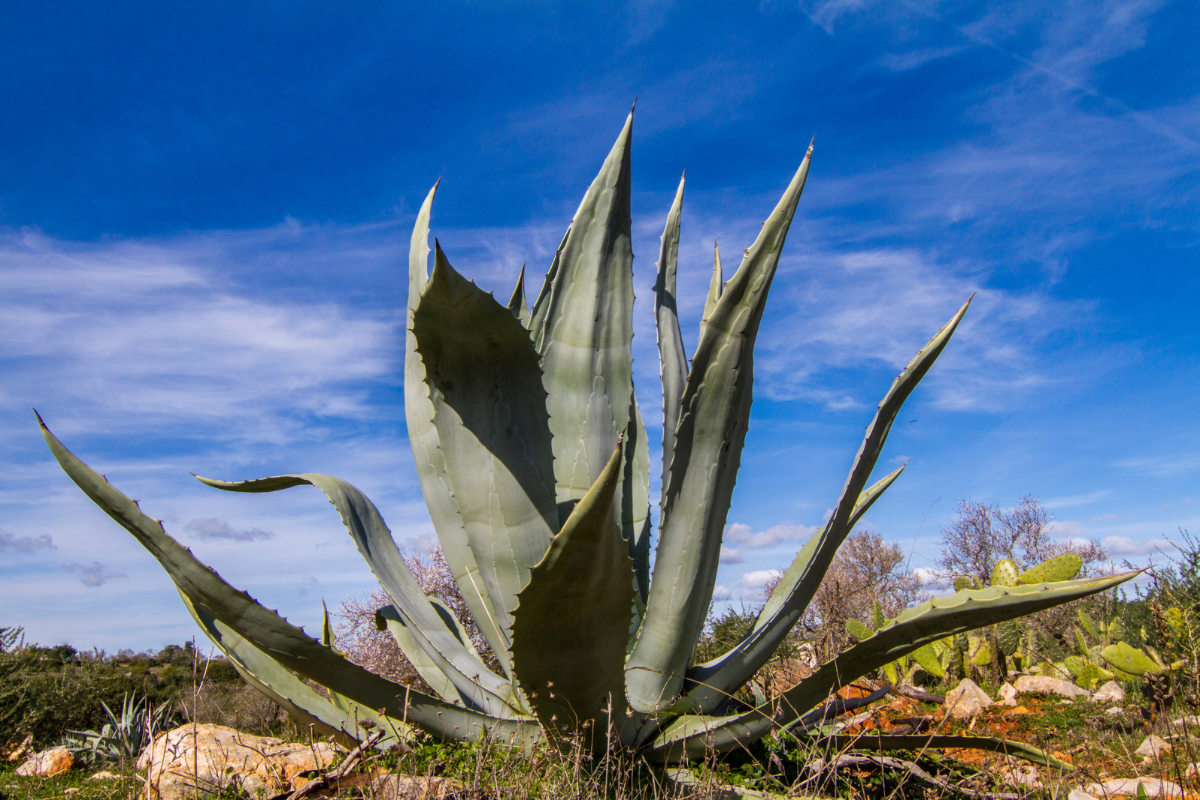
Century plant is a large architectural agave with a bold rosette of blue-green leaves and a towering flower spike at maturity. Agave americana suits hot sunny dry gardens where there is ample room for its broad rosette and sharp leaf tips.
- Grows well in
- Subtropical, Temperate, Arid / inland, Mediterranean
- Lifecycle
- Long-lived monocarpic succulent
- Light
- Full sun, Part shade
- Mature size
- Rosettes commonly reach 1–2 m high and 2–3 m wide; flower stalks may rise 5–10 m or more.
- Spacing
- Allow at least 2–3 m between rosette centres and more clearance from paths or structures.
- Growth habit
- Large rosette-forming succulent that produces offsets. The main rosette flowers once and then dies, while offsets can continue the colony.
- Native range
- Southern United States to Mexico.
- Natural habitat
- Desert and seasonally dry shrubland, rocky slopes and other dry open habitats in the southern United States and Mexico.
When to plant
Subtropical
March–June
Temperate
September–November
Arid inland
March–May
Mediterranean
September–November
Plant during mild to warm weather when soil is not saturated. In cold districts, spring gives roots time to establish before winter.
Planting
Plant with the crown above surrounding soil and keep the neck clear of mulch. Choose the site with mature width and sharp terminal spines in mind, away from narrow paths, play areas and gateways. Raised or sloping ground is useful in high-rainfall gardens.
Position and light
Full sun gives the firmest growth and strongest form. Light shade is tolerated, particularly in very hot inland districts, but deep shade produces weaker open growth. Covered specimens still need excellent light.
Soil
Free-draining mineral soil is important, especially where winters or wet seasons are cool. Sandy or gravelly soil suits it well. On heavier ground, mound the planting area or use a raised bed instead of a hole that collects water around roots.
Watering
Water new plants periodically while roots establish, allowing soil to dry between waterings. Established plants are drought tolerant and usually need little supplementary water. Potted plants need occasional deep watering but should not remain continuously damp.
Feeding
Established plants in ground generally need little feeding. A light low-nitrogen balanced fertiliser during active growth is enough on very poor soil. Rich feeding is unnecessary for compact architectural growth.
Pruning
Remove dead lower leaves with sturdy gloves and eye protection, cutting close to the base without damaging living tissue. Remove unwanted offsets while small. Consider the height and weight before dealing with a mature flower stalk.
Propagation
Offsets are the easiest propagation method. Separate pups with some roots attached and allow damaged surfaces to dry before replanting into free-draining soil. Seed can also be sown fresh.
Common problems
Root and crown rots are the main problems in poorly drained soil. Scale can occur on stressed plants. Physical injury from stiff marginal teeth and the terminal spine is a practical garden issue, so allow generous clearance around paths.
Safety notes
Leaf tips and marginal teeth can cause puncture and cutting injuries. Sap contains irritant compounds and can cause dermatitis, so use gloves, long sleeves and eye protection when cutting leaves or offsets.
Worth knowing
The name century plant exaggerates the wait for flowering. A rosette may flower after a few decades or sooner in favourable conditions, not at exactly 100 years. The huge branched flower stalk develops rapidly and attracts nectar-feeding wildlife.

Grow Century plant with Brancho
Add it to My Garden and Brancho works out what it needs next, timed for your climate.
How it grows around Australia
Growing this too? Share what you've noticed in your garden.
Grow a Little Wild
New plants to try, useful growing tips and a few garden jobs based on what you grow.