
Plant profile
Cooktown orchid
Dendrobium bigibbum Lindl.
Also known as Dendrobium bigibbum, Dendrobium phalaenopsis, Dendrobium bigibbum var. phalaenopsis, Cooktown orchid, Vappodes bigibba.
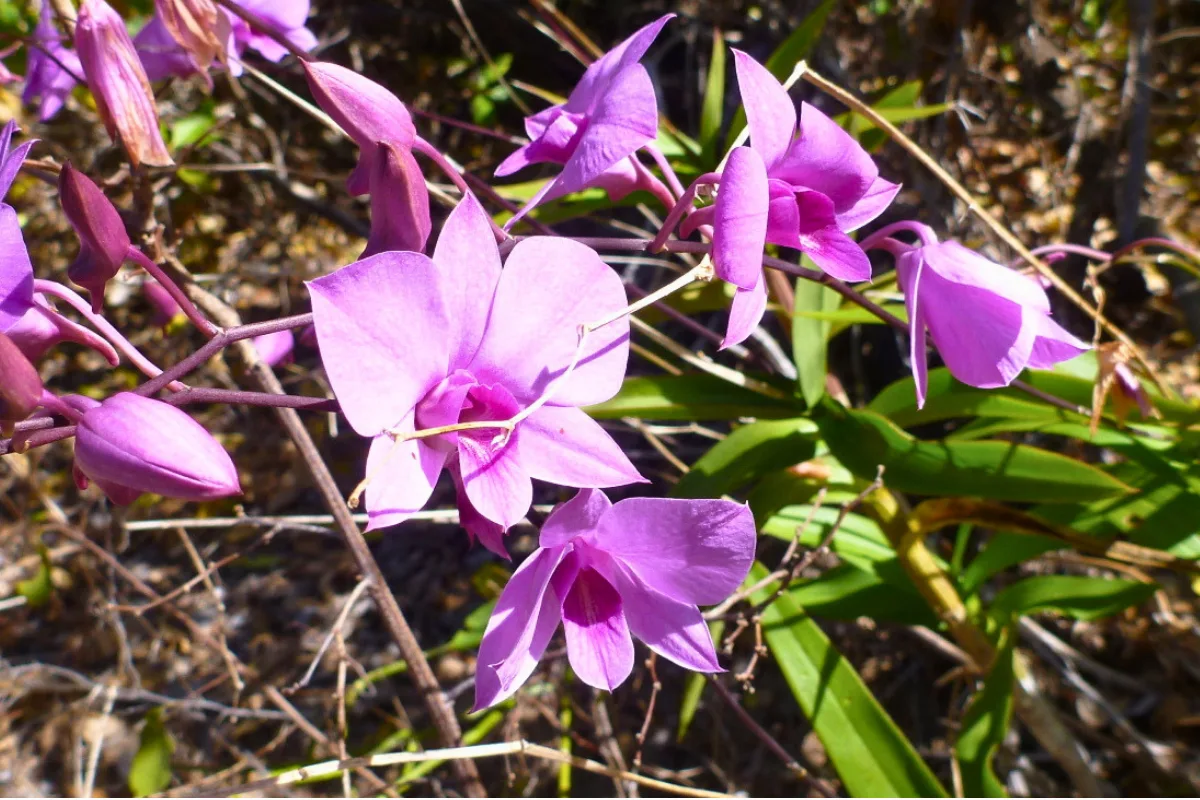
Cooktown orchid grows on the trunks of tropical trees and carries long sprays of mauve, pink or occasionally white flowers. It's Queensland's floral emblem, and a beautiful orchid to grow on a paperbark or in a hanging basket.
 By Elle · Published
- Grows well in
- Tropical, Subtropical
- Lifecycle
- Evergreen to semi-deciduous, cane-forming perennial epiphytic orchid
- Light
- Part shade, Full sun
- Mature size
- Canes often 30–80 cm tall, reaching about 1.2 m in some forms. Established clumps may eventually spread 50–100 cm across, with long arching flower sprays.
- Spacing
- For mounts allow at least 20–30 cm of open bark area, or use a basket sized to the clump and roots.
- Growth habit
- Clumping orchid with upright, fleshy water-storing canes, thick aerial roots and arching sprays of pink, mauve or occasional white flowers.
- Native range
- Native to northern Queensland, particularly Cape York, and also parts of New Guinea and the Tanimbar Islands in eastern Indonesia.
- Natural habitat
- Cooktown orchid grows on trees and rocks in Cape York's coastal scrub, monsoon thickets and open woodlands. Its roots often cling to the papery bark of Melaleuca trees. Some plants grow on rocky hillsides and in sheltered gullies. Much of this country has a pronounced wet and dry season.
When to plant
Tropical
September–January
Subtropical
October–February
Planting
Grow Cooktown orchid on a tree, a cork slab or in an orchid basket. Choose a tree with firm, rough bark that the new roots can grip. Paperbarks are especially good. In a pot or basket, use chunky orchid bark so air can reach the roots. Mount or repot when fresh roots are starting to grow. Secure the orchid with soft ties and a little hessian or sphagnum moss around the roots while it settles. Keep the new root tips steady until they've attached to the bark. You can remove the ties once the orchid holds on by itself.
Position and light
Give Cooktown orchid plenty of bright light and some direct sun. You'll get better flowers on a bright, open tree trunk than deep inside a shady canopy. Bring plants into stronger sunlight gradually so the leaves have time to adjust. In the tropics, a tree mount or open orchid house suits it beautifully. In subtropical areas, choose a warm, sheltered spot. For cooler parts of Australia, grow it in a hanging basket and move it into a heated greenhouse or another reliably warm, bright space over winter. Frost can damage the canes.
Soil
Cooktown orchid grows on bark and rock in the wild, so don't plant it in ordinary garden soil. Give the roots plenty of air with a tree mount or a loose orchid mix made from chunky bark. If the potting bark has broken down into fine pieces that stay wet for too long, repot when you see fresh roots starting. Choose a basket just big enough for the clump and some new growth.
Watering
Water generously while Cooktown orchid is making new roots and canes in warm weather. A plant mounted on an exposed trunk can dry out quickly, so check it more often than one in an orchid basket. Orchid growers Ross and Rhonda Harvey explain that wild populations on Cape York grow through a distinct wet season and a dry season, sometimes with little rain for two or three months. Give your plant less water when growth slows in cooler weather, allowing the roots to dry between drinks. The thick canes store moisture, although a badly shrivelling cane can mean it needs a drink.
Feeding
Feed lightly with a dilute orchid fertiliser while the plant is growing new roots and canes. Follow the product instructions and ease off in winter when growth slows. If it's growing in a basket, run plain water through the bark occasionally to wash out built-up fertiliser salts.
Pruning
Leave the healthy canes in place after flowering. They store food and water for the next growth cycle, even if an older cane loses its leaves. Cut away canes that are completely dead and dry. You can also remove spent flower stalks. If the orchid has outgrown its basket, divide the clump when new roots start growing, keeping several healthy canes in each piece.

Practical uses
Orchid breeding: Cooktown orchid has been used to breed many of the colourful hard-cane dendrobium hybrids grown today. Australian orchid growers have crossed it with other native and overseas dendrobiums to produce new flower colours and shapes. The Australian Native Plants Society explains its role in orchid breeding.
Cut flowers and decorations: Commercial growers raise Cooktown orchid hybrids for long-lasting cut flowers. Some are also grown specifically for edible flower decorations or freeze-dried floral products, as the USDA's Dried Botanical ID guide explains. If you want flowers for food, buy ones produced and sold for eating; regular nursery plants may have been treated with sprays.
Harvest
Cooktown orchid often flowers from late summer into winter in north Queensland, though plants in cultivation can flower at other times. An established clump may grow several arching sprays of mauve, pink or occasionally white flowers. For a vase, pick a spray when most of the flowers have opened. Cut the flower spike with clean secateurs and leave the green cane intact. The Australian National Botanic Gardens says the cut flowers can last about two weeks indoors.
Propagation
Divide a healthy clump when new roots are beginning to grow. Take a section with several good canes and roots, then tie it onto a new mount or pot it in fresh orchid bark. Water it as the roots establish. Some plants grow a little baby orchid, called a keiki, on an older cane. Wait until the keiki has roots at least a couple of centimetres long before removing it. Orchid seeds are almost dust-fine and normally need a specialist sterile growing setup, so division and keikis are much easier at home.
Common problems
Canes or roots rotting: Check how long the bark stays wet after rain or watering. If an old orchid mix has broken down, replace it when new roots are growing. Water less in cool weather. Not flowering: Give the orchid more light, a little at a time. A plant tucked into deep shade may grow canes without producing many flower sprays. Scale and mealybugs: Check where the leaves join the canes. Wipe or remove small infestations early and improve airflow around crowded plants. Cold damage: Move basket-grown orchids into shelter before cold nights. Cooktown orchid is a warm-growing species and won't handle frost.
Safety notes
Cooktown orchid is listed as Vulnerable under Australian federal and Queensland legislation. Buy nursery-propagated plants from a reputable grower and leave wild orchids in place.
Companion and understory planting
Grow Cooktown orchid on a paperbark (Melaleuca) or another established tree with firm, persistent bark. Put it on a bright section of the trunk where you can reach it to water and admire the flowers. The Australian National Botanic Gardens recommends an eastern or northern side of the tree.
You can grow a bird's-nest fern lower on the same trunk, where there's more shade, and ferns or other shade plants underneath. Give each plant room to grow and keep climbing vines from covering the orchid.
Tradition and history
Orchid belts on Cape York: The Australian Museum's Roth Collection includes a beautiful yellow belt made from orchid stems. Around the Pennefather, Wenlock and Embley rivers, women prepared thin strips of the outer layer of rock-lily orchid canes and wove them through handspun string. Men wore larger belts around their waists, while women wore smaller bands across their shoulders. Roth wrote that the belts were worn for dancing and fighting. The museum still has one collected from the Embley River in 1901, measuring 78 cm long.
Queensland's floral emblem: Ahead of Queensland's 1959 centenary, the Courier-Mail ran a public poll to choose a floral emblem. The Cooktown orchid came out on top among 10,917 entries, and the state officially adopted it on 19 November that year. Its flower colour was close to Queensland's maroon. The Australian National Botanic Gardens tells the story of the vote and the plant's complicated botanical naming.
Growth and roots
Cooktown orchid has thick aerial roots covered in a sponge-like layer called velamen. The roots absorb water when rain runs over them and gradually grip the bark or rock. They also catch nutrients washed down with rain and decaying organic matter.
It's an epiphyte, so its roots use the tree for support and don't feed on the living tree itself. On a mount, leave the roots exposed to the air and keep the orchid steady while new root tips attach.
References
- Cooktown Orchid — Queensland Floral Emblem, Australian National Botanic Gardens
- Dendrobium bigibbum — Australian Native Plants Society
- Dendrobium bigibbum — Kew Plants of the World Online
- Adams (2011) — Dendrobiinae systematics and pollination syndromes
- Queensland Council of Garden Clubs — Cooktown Orchid history
- EPBC Act threatened species list, compilation 12 March 2026
- Australian Museum — Catalogue of the Roth Collection, Volume 3 (orchid-fibre belts)
- CITES — CoP19 Information 9, Annex 2: orchids, ecology and pollinators
- Bribie Island Orchid Society — Dendrobium Bigibbum Orchids (Ross and Rhonda Harvey)
- USDA Dried Botanical ID — Dendrobium bigibbum
- Australian Government orchid identification factsheet — Vappodes bigibba
- Orchid Species Society — Phalaenanthe Dendrobium culture
- John Oxley District Orchid Society — Dendrobium Orchids
- Cooktown Botanic Gardens — Plant Collection Species List
- Royal Horticultural Society — Dendrobium bigibbum plant profile
Featured In
Grow Cooktown orchid with Brancho
Add it to My Garden and Brancho works out what it needs next, timed for your climate.
How it grows around Australia
Growing this too? Share what you've noticed in your garden.
Updates appear in My Brancho. Email alerts are not available yet.
Grow a Little Wild
New plants to try, useful growing tips and a few garden jobs based on what you grow.