Plant profile
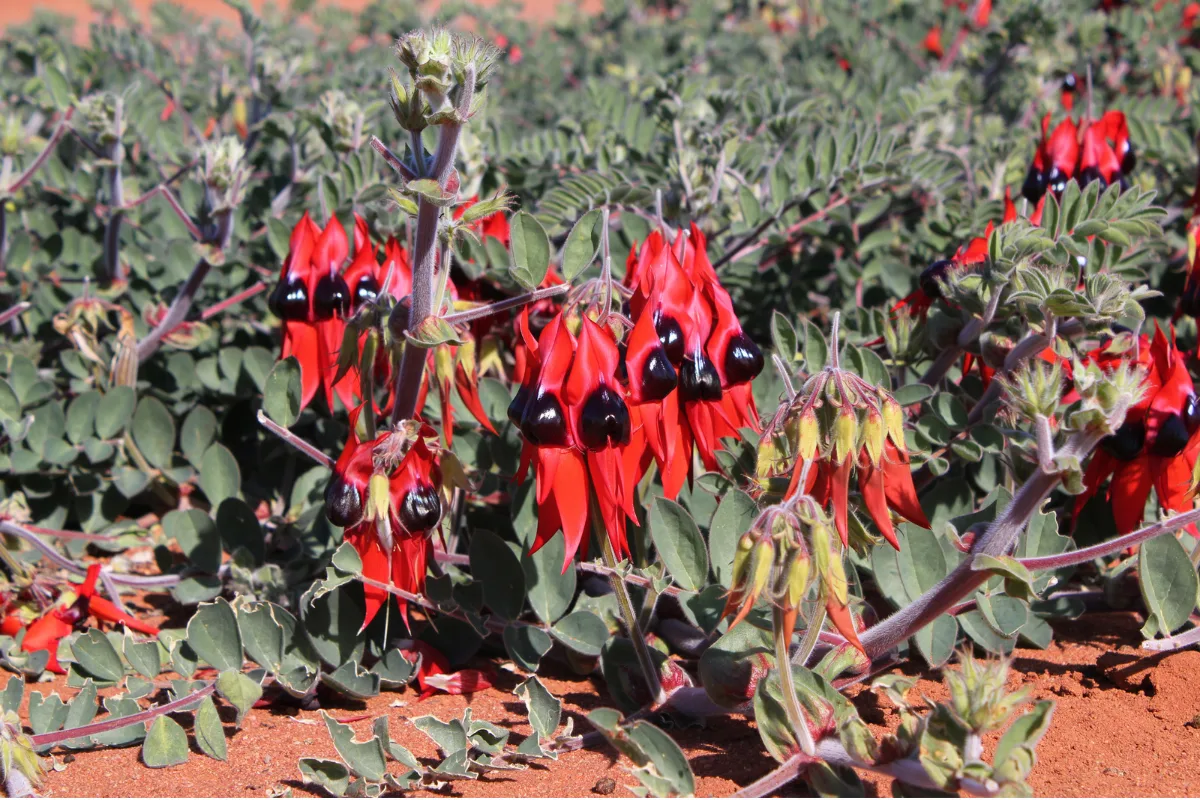
Sturt's Desert Pea
Swainsona formosa
Also known as Sturt desert pea, Ngooringa, Clianthus formosus.
Those gorgeous red flowers with shiny black centres are unmistakable! Grow Sturt's desert pea in a sunny, well-drained garden bed or deep pot, and give its trailing stems plenty of room to spread.
 By Elle · Published
 - Grows well in
- Arid / inland, Mediterranean, Temperate
- Lifecycle
- Short-lived perennial, usually grown as an annual
- Light
- Full sun
- Mature size
- Usually 20–40 cm tall, with trailing stems up to around 2 m; unusual upright Pilbara forms can grow taller.
- Spacing
- Allow roughly 1 m or more of open ground per plant; trailing stems can reach around 2 m. Give pots plenty of depth for the taproot.
- Growth habit
- Low, spreading native pea with soft grey-green leaves, upright flower stalks and a long taproot; usually grown as an annual.
- Native range
- Native to dry inland and western parts of mainland Australia, including Western Australia, South Australia, the Northern Territory, western New South Wales and parts of Queensland.
- Natural habitat
- Arid and semi-arid plains, open woodland, stony country and sandy or loamy ground, often flowering after good rain. Sometimes found on calcareous soils where runoff soaks down quickly.
When to plant
Temperate
September–November
Mediterranean
August–October
In warm temperate gardens, sow in spring after the worst frost has passed. In Mediterranean climates, late winter or spring can work as the soil warms. In arid regions, wait for good rainfall and suitable soil temperatures. Humid subtropical and tropical gardeners may have better luck with a protected pot during the drier part of the year, but those aren't its easiest climates.
Planting
Sow the seeds where you want the plants to grow, or start them in deep individual pots and move them while they're young. They form a long taproot early and don't like having it damaged. Scarify the seeds first so water can get through the hard coat. In temperate gardens, sow in spring after the worst frosts. In Mediterranean gardens, late winter to spring works well when the soil is warming. In inland dry areas, sow when the soil is warm and you've either had some rain or there's some on the way. You can also grow desert pea in a deep pot if your garden soil is too heavy or stays too wet.
Position and light
Give it full sun. You'll get the best flowers in an open, sunny position where taller plants won't shade it. It grows naturally in Australia's dry interior and does best in arid, Mediterranean and warm temperate gardens. Heavy summer rain and humidity make it much harder to grow. In humid areas, you can try a deep pot in the sun and putting it undercover during the wet season. It'll be hard to give it enough light this way, however. If you can find a spot undercover where it stills gets plenty of sun, that would be ideal. Even still, you may find it'll struggle with the humidity regardless.
Soil
Good drainage is the most important thing with soil. Sturt's desert pea grows naturally in sandy ground, including lime-rich soils. It can grow in acidic, neutral or alkaline soils, as long as the water drains away easily. For pots, try an open mix like the Australian National Botanic Gardens' recipe of 9 parts composted pine bark to 1 part washed river sand. Heavy clay is not a great choice unless you can give the plant a properly raised, well-drained bed. Keep the soil around the base of the stems fairly open so it doesn't stay wet for days on end.
Watering
Sturt's desert pea grows naturally in dry parts of Australia, so it doesn't need a lot of water once it's established. Let the soil dry out a bit between waterings, and make sure any excess water drains away. If you're growing it in a pot, check the mix more often during hot weather. Try to water the soil without wetting the leaves or the base of the stems, as they can develop rot if they stay damp. Gardening Australia has a clever watering method using two upright pipes placed near the sides of the pot. You pour water into the pipes so it reaches the deeper roots without soaking the base of the plant. Keep the mix lightly moist while seeds germinate, then reduce watering as the seedlings grow.
Feeding
Sturt's desert pea comes from dry country, but it can be quite hungry when you're growing it for flowers! The Australian National Botanic Gardens recommends regular controlled-release fertiliser for the best growth and flowering. Use a suitable fertiliser at the label rate, especially in a sandy potting mix where nutrients wash through quickly. Feed Sturt's desert pea while it's growing well. Regular feeding can encourage healthy growth and plenty of those gorgeous flowers.
Pruning
There isn't much pruning to do. Let the stems spread, and remove any damaged or rotting growth if you see it. You can pick a few flower stems for a vase, or leave the flowers to make seed pods. Most garden plants are grown for only one season, so it's usually easier to sow fresh seed.

Practical uses
A beautiful flowering feature for pots
Sturt's desert pea looks gorgeous spilling over the edge of a large pot or hanging basket. Some stems grow up to 2 metres long, so try placing a deep pot on a low wall or sturdy stand where the flowers can hang over the sides.
Growing it in a pot also makes it easier to control watering and drainage. You can move it under cover during heavy rain, which is especially handy if you live somewhere with wet summers.
Cut flowers
You can pick the flowering stems for a vase or use the longer runners in flower arrangements. Sturt's desert pea is also grown commercially for cut flowers, with Australian growers supplying florists.
If you'd like more flowers to pick, try tip-pruning young plants to encourage extra flowering stems. The Australian National Botanic Gardens experimented with this and managed to grow plants with 20–30 shorter stems carrying lots of flowers. That's a fantastic result for such a small plant!

Permaculture uses
A flowering groundcover for dry gardens
Sturt's desert pea makes a great groundcover for sunny, dry gardens. Its long stems spread across the soil, covering bare patches and helping to slow the growth of small weeds. The stems also provide some shade for the soil underneath.
Plant it along the edges of a native garden, between rocks or among other plants that like growing in sandy soil with good drainage. Give the stems plenty of room to spread, especially around smaller plants or seedlings.
Most plants finish after one growing season. Collect some seeds so you can grow another patch next year.
Nitrogen fixation and improving the soil
Sturt's desert pea belongs to the pea family, and it has a useful trick! Its roots can work with certain soil bacteria to take nitrogen from the air and turn it into a form the plant can use.
When the plant finishes growing, leave the roots in the ground to break down naturally. You can also chop up the old stems and leave them on the soil as mulch, or add them to your compost. As the plant material breaks down, it returns organic matter and nutrients to the soil.
Food for birds and insects
Sturt's desert pea provides food for birds and insects, making it a lovely addition to a wildlife-friendly native garden. New Holland honeyeaters have been recorded feeding on nectar and carrying pollen between the flowers. European honeybees also visit the flowers.
The plant also provides food for butterfly caterpillars! Long-tailed pea-blue butterflies use Sturt's desert pea as a host plant, with their caterpillars feeding on the buds, flowers and young seeds.
Try growing several plants together, with other flowering natives nearby. You'll have more flowers for visiting wildlife and a lovely little patch of Australian wildflowers.

Wildlife and pollinators
New Holland honeyeaters
New Holland honeyeaters (Phylidonyris novaehollandiae) have been recorded feeding on the nectar of Sturt's desert pea flowers. During a South Australian study, researchers watched the birds reach into the flowers and pick up pollen on their belly feathers.
The birds also brushed against the stigma, helping the flower receive pollen. The study took place with plants growing in open glasshouses, and researchers have also documented bird pollination in the wild.
If honeyeaters visit your plants, have a closer look at how they reach into the flowers. It's fascinating to see how the birds and flowers work together!
Bees visiting the flowers
European honeybees (Apis mellifera) have also been photographed visiting Sturt's desert pea flowers in Alice Springs. Keep an eye out for bees when your plants are flowering. You might find more insect visitors than you expected!
A food plant for butterfly caterpillars
Sturt's desert pea is also a food plant for butterfly caterpillars. Long-tailed pea-blue butterflies (Lampides boeticus) use it as a host plant, with their caterpillars feeding on the flower buds, flowers and developing seeds.
Common grass-blue butterflies (Zizina labradus) also use native peas as caterpillar food, and Butterfly Conservation SA includes Sturt's desert pea among its host-plant examples.
Leave some flowers and seed pods on your plants if you'd like to support the caterpillars. If you notice holes in the buds or pods, have a closer look. You might find a little butterfly caterpillar feeding there!
Harvest
Sturt's Desert Pea grows beautiful cut flowers. You can pick a few of the long flowering stems and put them in clean water. Leave some flowers on the plant if you want to save seeds. After flowering, you'll see pods developing. Wait until they're brown and dry, then collect them before they split and scatter the seeds. Store the dry seeds in a labelled paper packet somewhere cool and dry for your next sowing.
Propagation
Seed is the easiest way to grow Sturt's desert pea. The seeds have a hard coat, so gently rub one small spot with sandpaper or carefully nick the coat away from the seed's eye. Soak the treated seeds overnight, then sow them in a free-draining mix. Direct sowing works well, and deep individual pots are useful if you want to start seedlings somewhere protected. Keep the mix lightly moist until they germinate. Cuttings and grafting are possible too. Specialist growers have grafted desert pea onto New Zealand parrot's beak (Clianthus puniceus) to help plants live longer.
Common problems
Root and stem rot are the main things to watch. Sturt's desert pea often struggles when the soil stays damp, especially through humid weather. Fungi including Fusarium and Pythium have been linked with losses in cultivation. If stems collapse at the base or a plant suddenly wilts, check your drainage first. Snails and slugs can also chew on young seedlings, so keep an eye on them after germination.
Safety notes
The seeds contain trypsin inhibitors, which can affect protein digestion. They have a history of traditional food use with preparation, but I wouldn't eat garden-collected seeds without reliable preparation advice. Livestock observations are covered separately below.
Worth knowing
Sturt's desert pea is South Australia's floral emblem, adopted in 1961. Wild flowers are usually scarlet with shiny black centres, but pink, cream, yellow and white forms also occur. In the wild it's a perennial, though most gardeners grow it for a single season. The botanical name Swainsona formosa is accepted, but you'll still see the old name Clianthus formosus in older books.
Companion and understory planting
Grow it with other dry-country flowers
Try Sturt's desert pea with paper daisies and other low native flowers that grow well in full sun and sandy soil. The daisies add a different flower shape, and the desert pea can spread between them. Leave space between plants so the trailing stems get plenty of light and room to grow.
Along paths and around shrubs
You can plant it along the edge of a sunny path, where a few stems can trail over the stones. Keep the main walking area clear so the stems don't get stepped on.
It can also grow in open spots between dryland shrubs, provided they don't shade it. Keep the desert pea's crown clear of thick mulch and soggy soil. If you're growing it with plants that need a lot of watering, a separate deep pot may be easier.
Livestock and safety
Kew reports that Sturt's desert pea has been grazed lightly without ill effects, although it doesn't say which animals were grazing. Some other Swainsona species are poisonous to livestock.
We haven't found reliable information confirming its suitability for horses, cattle, sheep, goats or poultry.
Traditional uses
Traditional names from the Pilbara
Sturt's desert pea has several Aboriginal names across the Pilbara. A Western Australian field guide records thurlamartamarta in Ngarluma and thurlawirtingpirtiny in Yindjibarndi. A later collection of Pilbara plant names also records jalyurdura in Thalanyji and kapilyapilya in Nyamal. You'll find some different spellings in the two publications.
Nectar from the flowers
The flowers provided something sweet, too. The Western Australian Department of Conservation and Land Management recorded Aboriginal people sucking nectar from Sturt's desert pea flowers when water was scarce. A later compilation of Pilbara plant knowledge also records nectar being taken from the flowers.
Were the seeds eaten?
The sources give different accounts of the seeds. The Royal Botanic Gardens, Kew says Aboriginal people ate the seeds after roasting them, or ground the seeds and baked them into cakes. Kew doesn't identify which communities that account comes from.
The 2011 compilation Aboriginal Names for Pilbara Plants gives a different account. It includes the note "can't eat the seeds" for Sturt's desert pea. The IAD Press Pitjantjatjara/Yankunytjatjara Picture Dictionary also describes maḻukuṟu, the Sturt's desert pea, as a plant that isn't used for food.
Kew also reports that the seeds contain trypsin inhibitors, which can interfere with protein digestion. The sources don't explain why the accounts of seed use differ, so we've included both.
Flowers in decoration and art
Kew also records Aboriginal people using the flowers for decoration and mentions Sturt's desert pea in Aboriginal artwork and stories.
Growth and roots
How big does it get?
Sturt's desert pea is usually a low plant, around 20–40 cm tall, but its stems can spread about 2 m across the ground. Give it room to run between other plants or trail over the edge of a deep pot. Some wild plants from the Pilbara grow much taller.
Near paths, houses and septic systems
This is a small, soft-stemmed plant. There's no reason to expect it to lift paving or damage a building the way a large tree might. The main thing near paths is keeping the long stems out of the way so they aren't trampled.
It grows a long taproot, so choose a deep pot rather than a shallow one. I wouldn't plant it in a septic soakage area or near a constantly wet drain: the extra moisture makes root rot much more likely.
One season or several?
In the wild, Sturt's desert pea can live for more than one year, but most people grow it as an annual. If yours flowers beautifully, save some seeds and sow another batch in the next suitable season. You can get flowers about four months after sowing when conditions are good.
References
- Swainsona formosa — Plants of the World Online, Royal Botanic Gardens, Kew
- Swainsona formosa — Australian National Botanic Gardens
- Swainsona formosa — Botanic Gardens of South Australia Plant Selector
- Plant Profile: Sturt's Desert Pea — Gardening Australia
- Floral Development and Breeding System of Swainsona formosa — Jusaitis, 1994
- Root-nodule bacteria from indigenous legumes in the north-west of Western Australia — Yates et al. (2004), DPIRD WA research archive
- Sturt's Desert Pea — Australian National Botanic Gardens Floral Emblems
- Swainsona formosa — Australian Native Plants Society
- Sturt's desert pea — NSW National Parks
- Long-tailed pea-blue butterfly: larval food plants — South Australian Butterflies
- Common grass-blue butterfly: host-plant fact sheet — Butterfly Conservation SA (2018)
- European honeybees photographed on Sturt’s desert pea — Ausemade, Alice Springs
- Common Plants of the Pilbara — WA Department of Conservation and Land Management (1996), pp. 56–57
- Aboriginal Names for Pilbara Plants (Including Traditional Usages) — Djurali Taylor & Stephen van Leeuwen (compiled May 2011), Sturt’s desert pea entry (PDF p. 31)
- Sturt's desert pea (maḻukuṟu) — IAD Press Pitjantjatjara/Yankunytjatjara Picture Dictionary (plant listed as not a food source)
- Queensland Biosecurity Regulation 2016 — prohibited and restricted invasive plant schedules (current consolidated legislation)
- South Australia — List of Declared Plants (Landscape South Australia Act 2019), PIRSA
- Australian Government — Weeds of National Significance and established weeds
Grow Sturt's Desert Pea with Brancho
Add it to My Garden and Brancho works out what it needs next, timed for your climate.
How it grows around Australia
Growing this too? Share what you've noticed in your garden.
Grow a Little Wild
New plants to try, useful growing tips and a few garden jobs based on what you grow.