
Plant profile
Hairpin banksia
Banksia spinulosa Sm.
Also known as Banksia spinulosa, Hairpin banksia, Spinulosa banksia, Banksia Birthday Candles, Banksia Cherry Candles.
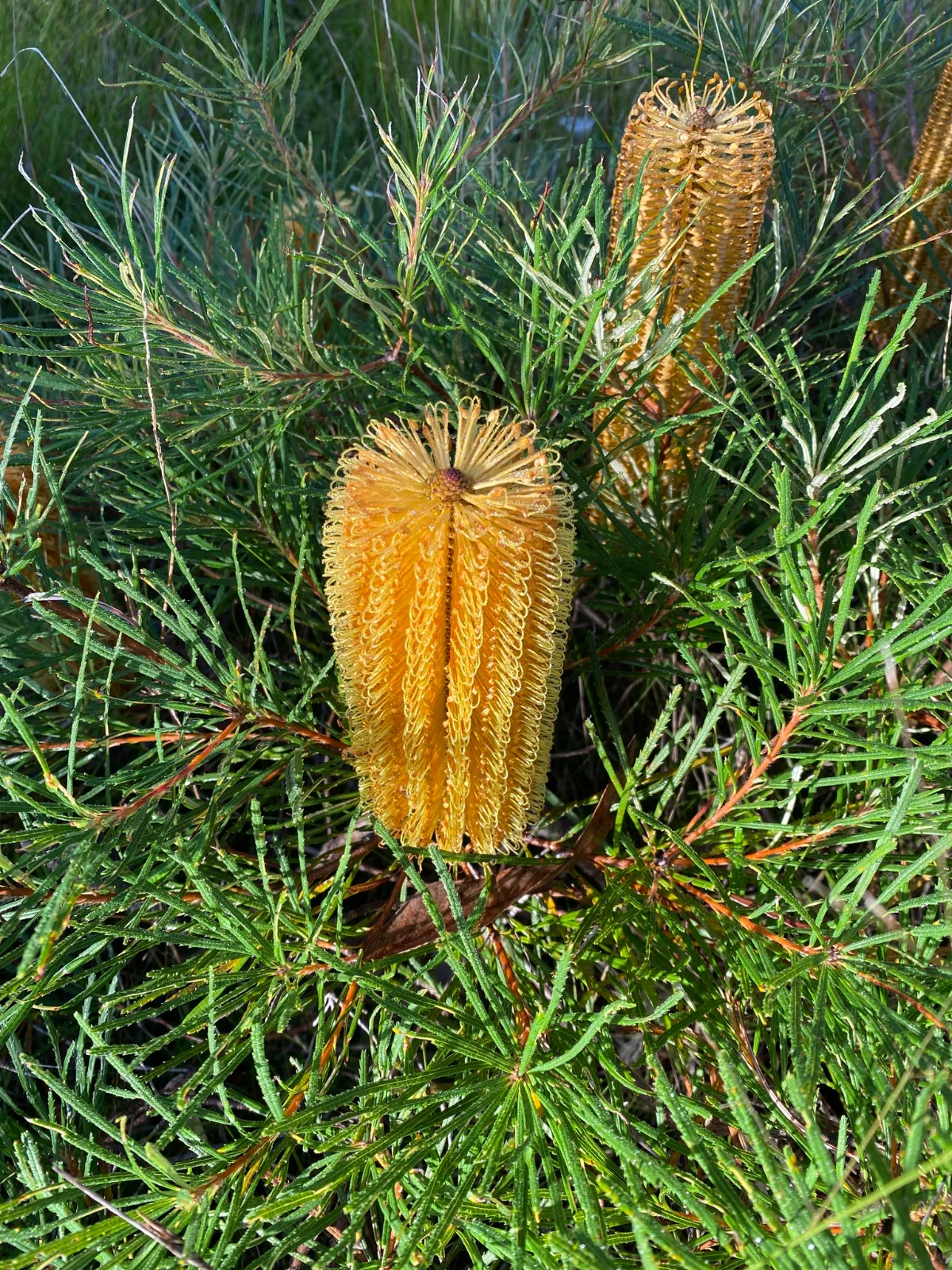
Hairpin banksia has gorgeous golden flowers through autumn and winter, and the visitors aren't just birds! Tiny pygmy-possums, sugar gliders and antechinuses have been photographed feeding among the spikes. Grow a full-sized shrub for a native garden or choose a compact selection for a pot.
 By Elle · Published
- Grows well in
- Temperate, Cool / mountains, Subtropical
- Lifecycle
- Evergreen woody shrub with lignotuber in typical wild form
- Light
- Full sun, Part shade
- Mature size
- Wild-type often 1–3 m tall and about 1–2 m wide; some horticultural dwarf selections reach only 30–60 cm high and 0.8–1.5 m across.
- Spacing
- Allow about 1.5–2 m for ordinary shrubs; compact named forms may be planted 0.8–1.2 m apart.
- Growth habit
- Rounded to upright multi-stemmed evergreen shrub with narrow leaves, golden upright flower spikes and distinctive hooked styles; typical form reshoots from a lignotuber.
- Native range
- The currently accepted narrower *Banksia spinulosa* occurs in eastern NSW and southern Queensland. Older broad classifications included several related forms extending into Victoria.
- Natural habitat
- Sandstone heath, open woodland and dry sclerophyll forest, typically on sandy or rocky soils, sometimes seasonally damp but well aerated.
When to plant
Temperate
March–May
Planting
Choose a sunny spot with room for the shrub to grow. Wild hairpin banksias commonly reach 1–3 m tall, while compact selections such as 'Birthday Candles' grow only around 50 cm high. Plant in autumn in mild areas, or in spring after heavy frosts. Water the pot before planting and put the shrub into the ground at the same depth it was growing in its container. Add mulch around the roots, keeping it clear of the stem. If you've got heavy clay that holds water after rain, I'd plant on a broad raised mound.
Position and light
Give hairpin banksia full sun for plenty of flower spikes. It can grow in part shade too, particularly in open woodland gardens, but you'll usually get a more compact shrub and better flowering in sunshine. It handles quite cold winters. Hairpin banksias grow at the Australian National Botanic Gardens in Canberra, where frosts are common. If you're in a hot, humid climate, grow it in an airy position with well-draining soil.
Soil
If you want plenty of hairpin banksia flowers, start with sandy, well-draining soil. It can grow in heavier ground too, as long as rain drains away. Here's an interesting result from real plantings in Victoria. Alf Salkin grew the typical Banksia spinulosa in sand at the Royal Botanic Gardens' Cranbourne site and in richer clay loam at G. Price's property in Harkaway. After five years, plants in the loam were bigger, but those in sand had many more flowers. Some sandy-site shrubs carried over 20 flower spikes! See Alf's growing comparison. Hairpin banksia also prefers soil that isn't strongly alkaline. In lime-rich ground, the leaves can turn yellow because the roots struggle to take up iron.
Watering
Water regularly while your hairpin banksia establishes, especially during its first summer. Check the soil under the mulch and give it a deep drink when it's starting to dry. Once established, it handles dry weather quite well. Give it extra water through extended hot weather. Compact plants in pots will need watering more often, so check the potting mix before giving them another drink.
Feeding
Hairpin banksias have special cluster roots that help them collect nutrients from poor soil. Established plants often grow beautifully without extra fertiliser. If yours needs feeding, use a small amount of slow-release fertiliser made for phosphorus-sensitive Australian natives. Avoid poultry manure and ordinary high-phosphorus fertilisers.
Pruning
You can leave hairpin banksia to grow into a naturally rounded shrub, or tip-prune the leafy shoots after flowering to encourage denser branches. If you want a compact hedge, give young plants regular light trims while they're growing. The typical wild form can regrow from its woody base after fire, but that doesn't mean every named variety will recover from cutting back into bare old branches. I'd stick with light pruning for compact nursery selections.

Practical uses
A flowering hedge: Grow several full-sized hairpin banksias together for a loose evergreen hedge. Trim the leafy shoots after flowering to encourage thicker branches, and give each shrub room to reach its mature width.
Compact plants for pots: 'Birthday Candles', 'Cherry Candles' and 'Coastal Cushion' are beautiful smaller selections. 'Birthday Candles' commonly grows around 50 cm high and 1 m wide; 'Coastal Cushion' can spread around 1.5 m.
Cut flowers: Pick a few golden flower spikes for the house. They look gorgeous in a tall vase, especially forms with dark burgundy or black styles.

Permaculture uses
Winter nectar for beehives: Hairpin banksia flowers through autumn and winter, making it useful around a property with honeybee hives. Plant several in sunny spots near the hive area and mix them with natives that flower at other times. In Bee Friendly, Mark Leech recommends hairpin banksia near overwintering hives to support the bees before spring.
A mixed native windbreak: Full-sized hairpin banksias can form part of a lower, evergreen layer in a windbreak, with taller trees behind them. Try them along the sunny edge where the flower spikes still get plenty of light. Leech also includes hairpin banksia among plants for farm windbreaks, and South Australia's Plant Selector recommends the 'Honey Pots' selection for mixed native windbreaks.

Wildlife and pollinators
Hairpin banksia feeds some wonderful little animals! Eastern pygmy-possums (Cercartetus nanus), sugar gliders (Petaurus breviceps) and brown antechinuses (Antechinus stuartii) have all been photographed feeding among its flower spikes in New South Wales. Pollen sticks to their fur as they climb through the flowers, helping the plants produce seed.
Ecologist Susan Carthew used remote cameras to watch these visits, as well as those of birds and insects. She found that the little mammals were probably slightly more effective pollinators than eastern spinebills. The flowers attracted visitors throughout both day and night.
Eastern spinebills (Acanthorhynchus tenuirostris) reach into the spikes with their long, curved beaks to drink nectar. They visited every flower spike Carthew monitored. And they're not the only birds interested in a flowering banksia: in an Australian Plants Society Mitchell newsletter, gardener Mike described lorikeets and noisy miners crowding around the flowers of his hairpin banksia.
Feathertail gliders (Acrobates pygmaeus) have another interesting connection. In Victoria, Vivienne Turner identified pollen from plants then called Banksia spinulosa in their diet. Wildlife researcher Ross Goldingay shared her finding in the Banksia Study Group's report. The older name covered a broader range of hairpin banksias than it does today.
Bees and moths visit the spikes too. Carthew photographed European honeybees and several kinds of moths. The moths carried much less pollen than the birds and mammals, but they were still regular flower visitors.
If you want to enjoy these wildlife connections, leave plenty of flower spikes on the shrub through autumn and winter. Some of the most interesting visits happen after dark!
Harvest
Hairpin banksia makes beautiful cut flowers! Pick a few spikes when the golden flowers are starting to open. Their dark red or black hooked styles look wonderful against the yellow flowers. Put the stems straight into water and remove any leaves that would sit below the waterline. Leave plenty of spikes on the shrub for the birds and small mammals that feed from them. Old woody seed cones look lovely in dried arrangements too. Leave a few on the plant to mature if you'd like to collect seed later.
Propagation
You can grow hairpin banksia from seed collected from mature woody cones. The seeds sit inside hard follicles, which may open after heat or drying. Sow the winged seeds in a clean, well-draining seed mix and keep it lightly moist. Seeds usually germinate in around 2–5 weeks in suitable conditions, according to the Australian National Botanic Gardens. Seedlings may start flowering after two or three years. If you've got your heart set on a particular dwarf variety or flower colour, grow it from cuttings or buy a named plant. Seedlings can turn out quite different from their parent.
Common problems
Yellow leaves: Lime-rich or strongly alkaline soil can make it difficult for the roots to take up iron. Check your soil before adding fertiliser. Root rot: Hairpin banksia is susceptible to Phytophthora and other root diseases. Good drainage is important, especially in warm, wet districts. Few flowers: Check how much sun your shrub receives. Some compact selections also flower more consistently than others. Australian Plants Society grower Karlo Taliana found his 'Cherry Candles' flowered heavily each autumn, while 'Birthday Candles' can be less reliable in some gardens.
Companion and understory planting
Try hairpin banksia with showy parrot pea (Dillwynia retorta), broad-leaved drumsticks (Isopogon anemonifolius) and small lomandras. They make a lovely sandstone-heath garden with flowers at different heights and plenty of fine foliage.
These plants also grow together naturally. A NSW sandstone woodland survey found Banksia spinulosa var. spinulosa with Dillwynia retorta and Isopogon anemonifolius, with low Lomandra obliqua among the ground plants.
I'd give the banksia room for its mature width, put the smaller shrubs alongside it and grow the lomandras near the front. Keep enough light around the flower spikes and space to reach them for picking.
For a courtyard or small patio, try a compact hairpin banksia in a broad pot, with native daisies or grasses in their own pots nearby.
Tradition and history
Banksia flowers have a long history as a source of sweet nectar for Aboriginal people. Flower spikes were soaked in water to make a sweet drink, and nectar could also be enjoyed directly from the flowers. The Australian National Botanic Gardens describes the preparation of these drinks using banksias in southeastern Australia.
There's a more local account for hairpin banksia too. Toohey Forest Environmental Education Centre in Brisbane describes the flowers being used for sweet drinks and the dried, woody seed cones as hairbrushes.
Hairpin banksia was formally described in 1793 by botanist James Edward Smith in A Specimen of the Botany of New Holland.
Growth and roots
Give wild hairpin banksia room to become a rounded, multi-stemmed shrub, usually around 1–3 m tall. The typical wild form can live 50–100 years, according to a NSW ecological review. Compact nursery selections may stay much smaller.
The typical form has a woody swelling at the base called a lignotuber, which can send up fresh stems after fire. Its fine cluster roots help gather nutrients from poor soil. It doesn't normally spread through garden beds by underground suckers.
Near paths, paving and walls: I'd grow a compact selection beside a sound path or wall, allowing enough room for its branches. Its shrub-sized root system suggests a lower risk of lifting paving than a large tree, although there's no need to plant tight against foundations. Remember to check the cultivar's mature width: Australian Plants Society gardener Karlo Taliana found his 'Cherry Candles' had spread to nearly 2 m after eight years, even though it's often sold as growing about 1 m wide.
Near sewer pipes: Keep clear of sewer mains and connections. South Australia's Plant Selector recommends at least 2 m for the 'Honey Pots' selection. I'd follow that guidance for 'Honey Pots' and check local service requirements for other cultivars, allowing extra space for larger shrubs.
Near septic systems: Grow hairpin banksia outside septic absorption areas, with access lids and drainage trenches kept clear. For the ground directly over absorption trenches, choose low, shallow-rooted plants permitted by your system.
Near pools: A compact cultivar in a large, well-draining pot can be lovely near a pool. Keep the pot away from drains and plumbing access points.
References
- Banksia spinulosa — NSW PlantNET
- NSW Cunninghamia 2000 — Banksia spinulosa ecology and wildlife
- Banksia spinulosa — Australian National Botanic Gardens
- Banksia spinulosa — Australian Native Plants Society
- Banksia spinulosa — Kew Plants of the World Online
- Susan Carthew (1993) — An assessment of pollinator visitation to Banksia spinulosa
- Australian Plants Society Mitchell newsletter (July 2022) — Mike's hairpin banksia, lorikeets and noisy miners
- Banksia Study Group Report 7 — soil comparison and feathertail glider pollen record
- Mark Leech (2012) — Bee Friendly, winter nectar and mixed farm windbreaks
- Karlo Taliana — Beautiful banksias for your east coast garden
- Tozer et al. (2003) — NSW sandstone woodland survey, Cunninghamia 8(1)
- Botanic Gardens of South Australia — Plant Selector: Banksia spinulosa 'Honey Pots'
- Australian National Botanic Gardens — Aboriginal plant use: Banksia species
- Toohey Forest Environmental Education Centre — Candlestick banksia
- Australian Cultivar Registration Authority — Banksia spinulosa 'Birthday Candles'
Featured In
Grow Hairpin banksia with Brancho
Add it to My Garden and Brancho works out what it needs next, timed for your climate.
How it grows around Australia
Growing this too? Share what you've noticed in your garden.
Updates appear in My Brancho. Email alerts are not available yet.
Grow a Little Wild
New plants to try, useful growing tips and a few garden jobs based on what you grow.