
Plant profile
Native pink hibiscus
Hibiscus splendens C.Fraser ex Graham
Also known as Hibiscus splendens, Pink hibiscus, Splendid hibiscus, Hollyhock tree, Pink cottonwood, Sabdariffa splendens.
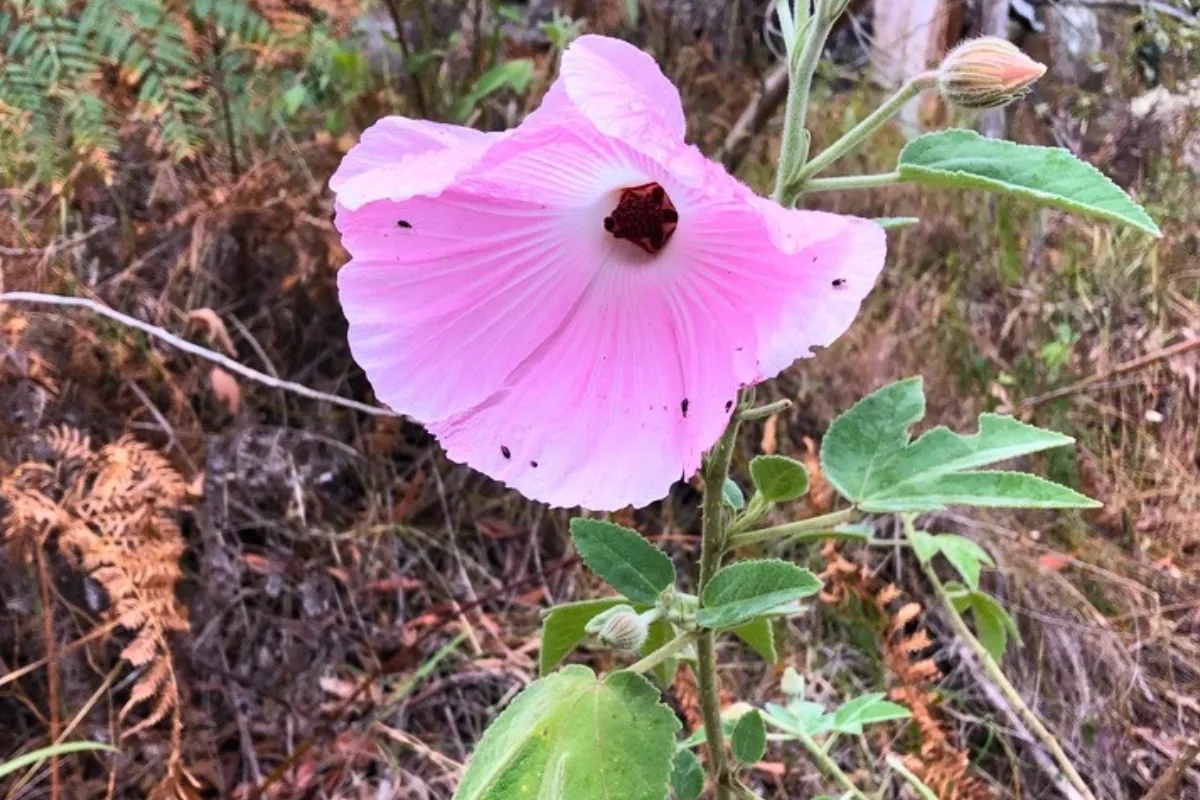
Native pink hibiscus has enormous pale-pink flowers with deep red centres. Tiny beetles pollinate the blooms, little flies breed inside them, and transverse moth caterpillars eat the leaves. You can grow it as a big flowering shrub or keep a cutting-grown plant in a pot. Its flowers and leaves have an edible history too.
 By Elle · Published
- Grows well in
- Tropical, Subtropical, Temperate
- Lifecycle
- Perennial shrub or small tree
- Light
- Full sun, Part shade
- Mature size
- About 3–6 m high and potentially 3–6 m across when unpruned. Cutting-grown plants can be maintained at a much smaller size in pots.
- Spacing
- Leave roughly 3–4 m between large shrubs, or more if you want to walk around them and collect seed safely.
- Growth habit
- Fast-growing, open woody shrub or small tree; large hairy, often lobed leaves, prickly stems, pink flowers with red centres, and bristly seed capsules.
- Native range
- Eastern Australia, from central coastal Queensland south through eastern New South Wales to around Wollongong.
- Natural habitat
- Open eucalypt forest, rocky slopes, clearings and the margins of drier rainforest and woodland, often where sunshine reaches newly opened ground.
When to plant
Tropical
September–December, January–April
Subtropical
September–December, January–April
Temperate
October–December, January–February
Planting
Give native pink hibiscus a sunny spot with room for a big, open shrub. It can reach 3–6 m high, with prickles along the stems, so I'd plant it back from a busy path. If you want something smaller and bushier, start tip-pruning the young shoots before they get tall. Plant during warm weather when you can water it regularly while it settles in. Spring suits gardens with cool winters; in the subtropics and tropics, try the warm growing season when the soil has moisture. Water the pot before planting, set it at the same depth, and mulch around the roots without covering the stem.
Position and light
Full sun gives you plenty of those huge pink flowers. Native pink hibiscus also grows in light shade, especially along the edges of open forest. I'd put it where the flowers will catch the morning light and you can see the dark red centres up close. In colder parts of its growing range, frost may burn the upper branches. Grow it near a warm, sheltered wall if frosts are common. The Australian Native Plants Society says established plants often send out fresh shoots lower down once the weather warms.
Soil
You can grow native pink hibiscus in a range of garden soils, including loam and lighter clay, provided rain can drain away. Mix compost through poor soil before planting and cover the surrounding ground with mulch. It naturally turns up in sunny openings beside forest, so it doesn't need a perfectly prepared rainforest bed. I'd give it a broad planting area where its roots can spread into the surrounding soil.
Watering
Water a newly planted hibiscus regularly while its roots settle into the garden. Once it's growing well, check beneath the mulch and give it a deep drink when the soil dries out during hot weather. A mature shrub usually needs less help, especially in a rainy subtropical garden. Mulch is useful around those big, leafy branches because it keeps the soil cooler and holds moisture.
Feeding
Start with compost and mulch. Native pink hibiscus grows strongly in good garden soil, and an established shrub may not need much fertiliser. If yours is making weak new shoots in poor soil, try a modest application of slow-release fertiliser suitable for Australian natives as the weather warms. Water it in and see how the new growth responds.
Pruning
If you want flowers within easy reach, tip-prune the young shoots to encourage more branches. After the main flowering season, shorten long shoots by about a third to help it grow into a fuller shrub. Australian Plants Society growers use this method with large native hibiscus. For a compact plant, I'd start with a cutting-grown hibiscus in a big pot and trim it regularly while the stems are green. Wear gloves when you prune, because the branches can be prickly. If frost damages the top, wait for spring shoots to show you what needs cutting.

Practical uses
Flowers you can eat: Here's a lovely surprise: Ipswich City Council describes Hibiscus splendens flowers, leaves and seeds as edible. The Australian Plants Society's Food Plants Study Group also listed its buds, flowers, shoots and roots among the edible specimens brought to a Rockhampton meeting in 2005. If you're growing one for the kitchen, start with a few fresh petals in a salad. I'd leave most of the flowers on the shrub for insects and birds.
A huge flowering shrub: The pale-pink flowers with dark red centres can be around 15 cm across, and new blooms keep appearing from spring into summer. Plant it where you can enjoy the flowers without having to squeeze past prickly branches.
Fibre with a history: In an 1894 account published in The Paper Trade Journal, Melbourne Botanic Gardens director W. R. Guilfoyle described fibre from this exact hibiscus as suitable for cordage, fishing line and paper. It's a fascinating use for the bark of a plant most gardeners grow for its flowers.

Permaculture uses
I'd grow native pink hibiscus along a sunny food-forest edge, where its big leaves and fast growth can fill the space while slower trees establish. It's useful for a loose flowering screen, and you can cut back leafy branches for compost or mulch as the planting develops.
Its flowers support a whole little community of insects. Some small beetles help pollinate them, while another tiny fly uses the blooms as a place to breed. Plant several native flowering shrubs nearby so there's something available before and after the hibiscus flowers. I'd keep the hibiscus in the sunny outer row, with smaller shade-loving plants around the edge as its branches spread.
You can also raise spare plants from cuttings to fill gaps or share with other gardeners. That makes it easy to replace a shrub or try one in a big pot.

Wildlife and pollinators
Native pink hibiscus supports a much richer little wildlife community than you might expect from its huge pink flowers.
Tiny beetle pollinators: In an Australian Native Plants Society study-group newsletter, Colleen and Geoff Keena discuss research by Geoff Williams and Paul Adam showing that small flower beetles, usually from the Nitidulidae family, pollinate Hibiscus splendens. Look closely inside a fresh bloom and you may find beetles moving among the stamens. They sometimes chew petals too, so not every hole in a flower is a gardening disaster.
Flies that grow up in the flowers: Australian Museum researchers Shane McEvey and J. S. F. Barker explain that the tiny native fly Scaptodrosophila hibisci breeds in H. splendens flowers. Its larvae develop inside these short-lived blooms. Their original research gives this hibiscus a particularly interesting role beyond providing nectar.
A caterpillar food plant: The Australian Caterpillars website lists H. splendens among plants eaten by transverse moth (Xanthodes transversa) caterpillars. The caterpillars change colour as they grow, sometimes showing yellow bands, dark spots and a red mark near the tail. Leave a few leaves for them if you can spare them.
Bird visitors: The Australian Native Plants Society also names native pink hibiscus among the hibiscus flowers visited by honeyeaters. Watch for birds visiting the flowers, though the beetle research suggests insects are particularly important pollinators here.
Harvest
You can enjoy the flowers on the shrub, where new ones keep opening through the warmer months. Each bloom usually lasts just a day or two, so a vase isn't their best use. Ipswich City Council identifies the flowers, leaves and seeds of Hibiscus splendens as edible. I'd try a few clean, freshly opened petals as a colourful salad garnish, using a correctly identified plant that hasn't been sprayed. For seed, leave some flowers to form their bristly capsules. Once the capsules are dry, wear gloves to collect them and tip the seed onto paper. Those fine hairs can be very irritating if they get into your skin.
Propagation
Seed germinates without special treatment. Collect it from mature, dry capsules using gloves, then sow shallowly in warm seed-raising mix and keep it lightly moist. Australian Native Plants Society says soaking the seed or gently scratching its coat may speed germination, but you can sow fresh seed as it is. Cuttings are particularly handy if you want a shrub for a large pot. Take firm, healthy shoots, cut just below a node and put them into a free-draining propagation mix; rooting hormone can help. In an Australian native hibiscus growing account, cutting-grown plants often flowered within about six months, while still small enough for pots. Keep tipping the new shoots to make a bushy plant.
Common problems
Hibiscus beetles: Small flower beetles may nibble the petals, but they're also important pollinators of native hibiscus. I'd leave them alone unless you're seeing serious damage. In a Barung Landcare garden account, Joan Dillon found that her hairy-leaved Hibiscus splendens escaped the beetle damage affecting another hibiscus. Harlequin bugs: You may find colourful, sap-feeding bugs on the young shoots and capsules. Australian Native Plants Society says they rarely cause major trouble. Frost damage: If the upper branches die back in winter, look for fresh growth farther down the stems in spring, then trim away the dead portions.
Safety notes
The seed capsules have fine hairs that can cause serious skin irritation, and the stems can be prickly. Wear gloves for pruning and seed collecting. I'd plant a full-sized shrub away from narrow paths where people or animals would brush against the branches.
Worth knowing
Botanists published the name Sabdariffa splendens for this plant in 2025. Most Australian native nurseries and gardeners still call it Hibiscus splendens, so you'll see both names.
Companion and understory planting
There's a wonderful real garden example from Colleen and Geoff Keena at Glamorgan Vale, Queensland. They grew Hibiscus splendens near H. divaricatus, and a seedling appeared between them that became the beautiful native hybrid 'Geoffs' Haze'. It had enormous, downward-facing pink flowers and grew about 3–4 m tall and wide.
In your garden, try native pink hibiscus with another flowering native hibiscus where you have plenty of sun and space. They can make an interesting mix, and some seedlings may have different flowers from their parents. For a layered forest-edge planting, I'd put native ginger or ferns nearer the shadier side, where the big hibiscus leaves give them some protection from hot afternoon sun.
Tradition and history
At White Rock–Spring Mountain Conservation Estate near Ipswich, native pink hibiscus grows in a landscape of deep cultural importance to Traditional Owners. White Rock, known as Nugum/Boogun, is a protected sacred place. Ipswich City Council's account specifically identifies Hibiscus splendens as a plant with edible flowers, leaves and seeds, and describes its bark being used to make netting.
Growth and roots
In the ground, native pink hibiscus can make a large, open shrub with woody stems and a wide root system. Give it plenty of room, especially if you want to let it grow naturally among other forest-edge plants.
There's a useful detail from Australian native hibiscus growers: seedlings develop a stronger main taproot, while cuttings produce a more fibrous root system. That helps explain why cutting-grown plants are easier to keep compact in pots. I'd grow a cutting in a generous pot if you want flowers close to the house, and keep tip-pruning the new branches before they get tall and woody.
References
- Hibiscus splendens — Australian Native Plants Society
- Sabdariffa splendens — Kew Plants of the World Online, accepted 2025 name
- Sabdariffa splendens — International Plant Names Index, 2025 new combination
- Hibiscus splendens — Useful Tropical Plants (historical fibre citation)
- The Paper Trade Journal 1894 — Hibiscus splendens fibre, Dr W.R. Guilfoyle account
- Focus on Flora: Native Hibiscus — Spencer Shaw, Brush Turkey Enterprises (Sunshine Coast)
- Hibiscus splendens — NSW PlantNET FloraOnline official native habitat and morphology
- In Flower, February 2012 — Australian National Botanic Gardens Hibiscus splendens specimen
- Friends of Maroochy Botanic Gardens — Hibiscus splendens flowering specimen
- Sabdariffa splendens accepted name — Kew Plants of the World Online
- 2025 reclassification — McLay and Barrett, Australian Systematic Botany
- Colleen and Geoff Keena, Australian Native Plants Society Hibiscus Study Group Newsletter 30 (2013)
- Native hibiscus for pots — Australian Plants Online, 1997
- Native hibiscus uses and wildlife — Australian Plants Online, 2003
- McEvey and Barker (2001) Scaptodrosophila hibisci breeding in Hibiscus flowers — Australian Museum
- Don Herbison-Evans and Stella Crossley — Xanthodes transversa hostplants, Australian Caterpillars
- Ipswich City Council — White Rock–Spring Mountain, splendid hibiscus food and fibre
- Ipswich Council — Discover Ipswich guide with cultural setting
- Australian Plants Society Food Plants Study Group Bulletin 50 — Rockhampton edible hibiscus
- Joan Dillon — Barung Landcare Autumn 2019, native hibiscus beetle comparison
- B. Ballina Shire native plant garden guide — Hibiscus splendens
Featured In
Grow Native pink hibiscus with Brancho
Add it to My Garden and Brancho works out what it needs next, timed for your climate.
How it grows around Australia
Growing this too? Share what you've noticed in your garden.
Updates appear in My Brancho. Email alerts are not available yet.
Grow a Little Wild
New plants to try, useful growing tips and a few garden jobs based on what you grow.