
Plant profile
Purple coral pea
Hardenbergia violacea (Schneev.) Stearn
Also known as Hardenbergia, Purple coral pea, False sarsaparilla, Native sarsaparilla, Happy wanderer, Hardenbergia violacea Happy Wanderer.
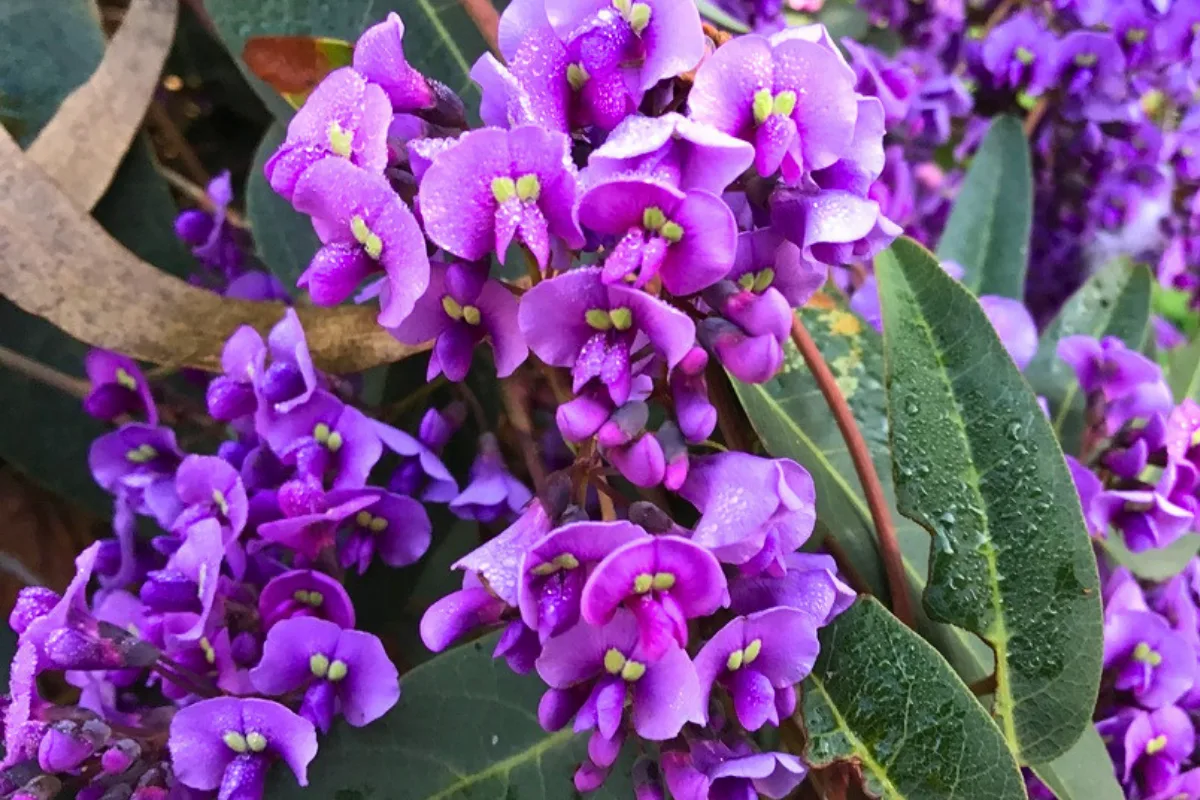
Purple coral pea produces beautiful sprays of violet flowers from winter into spring. Grow it over fences, across garden banks or in pots, with compact varieties for smaller spaces. Native bees visit the flowers, butterfly caterpillars feed on the plant, and ants help carry its seeds away.
 By Elle · Published
- Grows well in
- Subtropical, Temperate, Cool / mountains, Mediterranean, Arid / inland
- Lifecycle
- Evergreen perennial climber, groundcover or shrub
- Light
- Full sun, Part shade
- Mature size
- Climbing forms commonly have 2–4 m stems; vigorous cultivars spread farther. Trailing and shrubby cultivars vary considerably.
- Spacing
- Climbers: about 1–2 m apart for fence cover; allow for each cultivar's mature spread.
- Growth habit
- Evergreen climbing or prostrate woody subshrub; forms range from vigorous twiners to low groundcovers and compact shrubs.
- Native range
- Queensland, New South Wales, Victoria, South Australia and Tasmania.
- Natural habitat
- Open eucalypt woodland, dry and wet sclerophyll forest, heath and rocky slopes. Some plants scramble through shrubs; others trail across the ground.
When to plant
Subtropical
March–May
Temperate
March–May
Cool / mountain
September–November
Arid inland
March–May
Mediterranean
March–May
Autumn and spring are the easiest planting times in most climates; avoid planting into severe frost or peak inland heat.
Planting
Purple coral pea can climb a trellis, trail across a garden bank or grow as a compact shrub, depending on the variety. The familiar 'Happy Wanderer' is a vigorous climbing selection; compact cultivars suit pots and narrower garden beds. Plant in autumn in mild districts, or in spring after the heaviest frosts in colder areas. Water the nursery plant, set it at the same depth it was growing in its pot and mulch around the base. For climbing forms, install horizontal wires or trellis mesh before the stems begin spreading. Guide the young shoots across the support for a well-covered fence.
Position and light
Full sun brings the best flowering, with sprays of violet, purple, mauve, pink or white pea flowers from winter into spring. Purple coral pea also grows in part shade and looks beautiful scrambling through an open woodland garden. Established plants handle dry weather and moderate frost. In a hot, humid district, give the plant good airflow and well-draining soil. Forms from different parts of Australia vary, so a nursery selection grown for your climate is a good starting point.
Soil
Purple coral pea grows in sandy loam, light clay and rocky soil. It can do well in relatively poor ground, provided water drains away. If your clay stays wet after rain, plant on a broad raised mound. For pots, use a good-quality potting mix. The Botanic Gardens of Sydney grows trailing varieties such as 'Flat White' and 'Carpet Royale' in enriched, slightly acidic, well-draining soil. Their long stems spread beautifully over the sides of raised beds.
Watering
Water regularly through the first growing season, checking the soil around the roots as the weather warms up. Established plants handle dry periods well. Give them a deep drink during extended hot weather, especially while they're putting on new growth. Potted plants need more frequent watering. Check the mix every few days in summer, particularly when the pot sits in full sun.
Feeding
Purple coral pea belongs to the pea family and can form nitrogen-fixing nodules on its roots. This helps it grow in relatively poor soil. Most established plants need little feeding. Give yours a light application of slow-release fertiliser in spring if growth is pale or slow. Container-grown plants need more regular feeding as nutrients in the potting mix are used up. On Gardening Australia, Clarence Slockee recommends liquid fertiliser every few weeks during flowering, with slow-release fertiliser in spring and autumn.
Pruning
Prune after the main flowering display in spring. Cut long stems back to healthy side shoots and remove older, tangled growth. Climbing varieties respond well to regular trimming and can make a dense flowering screen. Compact shrub varieties need only a light prune to maintain their shape. Vigorous selections such as 'Happy Wanderer' can handle a harder cut-back when they've become overgrown.

Practical uses
Fences and trellises: Climbing selections produce long, twining stems and masses of flowers through winter and spring. 'Happy Wanderer' is particularly vigorous, while 'Pink Fizz' has soft pink flowers and a more restrained habit.
Flowering groundcovers: Trailing forms such as 'Purple Falls', 'Flat White' and 'Carpet Royale' spread over open garden beds, rockeries and banks. Their glossy foliage makes a lovely backdrop for the flowers.
Compact shrubs: 'Mini Haha' and 'Blushing Princess' give you a smaller, bushier plant for pots, borders and low flowering hedges.
A flowering tower in a pot: On Gardening Australia, Clarence Slockee planted purple and white hardenbergias together in a pot about 50 cm wide. He built an A-frame from sturdy sticks around 2 m long and trained the climbers over it. It's a beautiful way to grow them on a patio. See Clarence's demonstration.

Permaculture uses
Permanent flowering groundcover: Trailing hardenbergias can spread across sunny banks and woodland edges. 'Flat White' and 'Carpet Royale' form dense mats of shallow-rooted foliage that cover the soil. They're useful where you want a flowering native layer around established shrubs or across a broad garden bed.
Nitrogen fixation: Purple coral pea can form nodules with nitrogen-fixing bacteria. This helps the plant grow in relatively poor soils. It's useful as part of a mixed native planting, although the nodules don't make it a replacement for feeding hungry vegetables.
Bee forage: The winter and spring flowers offer nectar and pollen to visiting bees. In Bee Friendly, Mark Leech includes hardenbergia among the plants used by honeybees in South Australia. Grow it with other flowering natives to extend the availability of flowers through the year.

Wildlife and pollinators
Purple coral pea has some wonderful relationships with native insects, including bees visiting its purple flowers and caterpillars feeding among the leaves.
Native bees: Blue-banded bees visit the flowers on the Sunshine Coast, where Maroochy Regional Botanic Garden recommends purple coral pea as a native bee plant. At the Australian National Botanic Gardens in Canberra, Roger Farrow and Tim Leach photographed a female metallic green carpenter bee (Xylocopa aeratus) visiting the flowers in spring 2019.
Another native bee, Trichocolletes venustus, regularly visited purple coral pea flowers during research at Scheyville National Park in NSW. These bees have a fascinating connection with native donkey orchids (Diuris). The orchids mimic pea flowers closely enough that bees sometimes visit them while searching for food.
Butterfly caterpillars: Purple coral pea is a food plant for the common grass-blue butterfly (Zizina labradus). The tiny adult butterflies have soft blue upper wings and spotted undersides; their caterpillars feed on parts of the plant's fresh growth.
Moth caterpillars: The painted apple moth (Orgyia anartoides) also uses hardenbergia as a host plant. Its hairy caterpillars are easy to recognise from the four pale tufts along their backs.
Ants and seeds: The hard seeds have small, oily attachments called elaiosomes, which attract ants. The ants carry the seeds away to feed on the oily part. Australian researchers P. J. Hocking and A. A. Kortt measured these attachments in 1987 and found they contained about 34% oil. It's a remarkable little seed-dispersal partnership.
Other native moths, butterflies, bees and wasps feed at the flowers, while seed-eating birds and insects take some of the ripe seed. Thick trailing foliage also offers cover for small reptiles and insects.
Harvest
The purple flower sprays look lovely in a small vase. Cut fresh stems while plenty of the flowers are open and put them into water. After flowering, the plant develops flat seed pods around 2–5 cm long, usually with several hard seeds inside. For propagation, collect the pods as they turn brown and begin drying, before they split open and scatter the seeds.
Propagation
Purple coral pea grows readily from seed or cuttings. The seeds have a hard outer coat. Gently rub one side with sandpaper or a small file, then soak them in warm water overnight. Sow in seed-raising mix and keep it lightly moist while it germinates; seedlings commonly appear in around 3–4 weeks. Take cuttings from firm new growth during the warmer months and put them into a free-draining propagation mix. Cuttings are best for reproducing named varieties with the same flower colour and growth habit.
Common problems
Powdery mildew: A white, powdery coating may develop on leaves during cool, damp weather. Remove heavily affected growth and thin crowded stems to improve airflow. Leaf damage: Some caterpillars eat the softer tissue between the leaf veins, leaving a lacy pattern. Check which insects are feeding before removing them; purple coral pea supports native butterfly and moth caterpillars. Scale and mealybugs: These can build up around crowded stems and leaf joints. Prune out crowded growth and remove small infestations by hand.
Safety notes
A Queensland flora reference reports that Hardenbergia violacea may cause colic-like symptoms in horses. Keep it outside horse grazing areas. Safe fodder use for cattle, sheep, goats and poultry has not been established.
Worth knowing
The species naturally varies in flower colour from deep purple through mauve and occasionally white. Tip pruning young growth helps build a denser plant and gives better coverage over a support.
Companion and understory planting
Purple coral pea looks gorgeous alongside native daisies, grasses and small woodland shrubs. At the Geelong Pollinator Garden in Victoria, it appears in a planting palette with cut-leaf daisies (Brachyscome multifida), common everlastings (Chrysocephalum apiculatum), running postman (Kennedia prostrata) and native grasses.
In a sunny garden bed, try a trailing hardenbergia with cut-leaf daisies and everlastings along the front. Lomandras or wallaby grasses add height behind the flowers.
Climbing forms can also scramble through open native shrubs or grow on a trellis behind smaller plants.
Tradition and history
Purple coral pea has a fascinating place in Wiradjuri plant knowledge. Known as Ngawang, its long, flexible stems were used to make rope and string for baskets.
Its flowering also marked an important time of year. Wiradjuri people associated the flowers of Ngawang with Guya (fish) in rivers and lakes becoming fat and ready to catch.
Traditional preparations of the flowers were used as a mouthwash for ulcers and for chest complaints. These uses are documented by Williams and Sides in Wiradjuri Plant Use in the Murrumbidgee Catchment.
The plant was first described botanically in 1793 as Glycine violacea. Its present genus, Hardenbergia, honours Franziska, Countess von Hardenberg, who supported botanical work.
Growth and roots
Purple coral pea grows from a woody rootstock, producing long, flexible stems that may climb through shrubs or trail across rocky ground. Climbing forms commonly have stems around 2–4 m long; compact varieties can remain under a metre tall. The rootstock can reshoot after damage or fire.
Near paths and paving: Compact and trailing varieties soften the edges of paths beautifully. Their roots pose a lower lifting risk than those of large trees, although trailing stems need trimming to keep walking areas clear.
Near fences and walls: Climbing hardenbergias twine around supports. Install wires or mesh against a wall or fence and trim stems around gates, gutters and rooflines.
Near house foundations: Plant far enough from footings for maintenance and access. Most of this plant's visible spread comes from its stems. The species is not known for the aggressive structural roots of large trees.
Near pipes and septic systems: Keep woody rootstocks clear of underground pipework, septic absorption trenches and inspection covers. Even shallow-rooted groundcover selections should follow the planting rules for your particular system.
Near pools: A compact variety in a large pot makes a beautiful flowering feature, while a climbing form can cover a freestanding trellis nearby.
References
- Kew Plants of the World Online — Hardenbergia violacea, accepted taxon and distribution
- NSW PlantNET — Hardenbergia violacea taxonomy, flowers and pods
- Australian Native Plants Society — Hardenbergia violacea and cultivar identities
- Botanic Gardens of Sydney — Growing purple coral pea
- Gardening Australia — Hardenbergia, cultivation and pruning
- Clarence Slockee — In-spiring Flowers, Gardening Australia
- Maroochy Regional Botanic Garden — Native sarsaparilla, bees and common grass-blue host
- Maroochy Regional Botanic Garden — Butterfly-friendly plants host species table
- Indsto et al. — Pollination of Diuris maculata by male Trichocolletes venustus
- Roger Farrow and Tim Leach — Flowers visited by the Metallic Green Carpenter Bee, Fronds 100
- Caterlog — Painted Apple Moth Orgyia anartoides larval food plants
- P. J. Hocking and A. A. Kortt (1987) — Ant dispersal of Hardenbergia violacea seed
- Wiradjuri Plant Use in the Murrumbidgee Catchment — Williams and Sides
- Royal Botanic Gardens Tasmania — Hardenbergia violacea Tasmanian conservation listing
- Tasmania NRE — Threatened vascular plants status, Hardenbergia violacea
- Queensland Australian Tropical Rainforest Plants — Hardenbergia violacea horses
- South Australian Botanic Gardens Plant Selector — Hardenbergia violacea
- Warrnambool Plant Selector — Purple coral pea insect and bird uses
- Hardenbergia violacea revegetation guide — propagation, insects and seed, regional detail
- Geelong Pollinator Garden — public planting guide
- Mark Leech — Bee Friendly Australian planting guide
Featured In
Grow Purple coral pea with Brancho
Add it to My Garden and Brancho works out what it needs next, timed for your climate.
How it grows around Australia
Growing this too? Share what you've noticed in your garden.
Updates appear in My Brancho. Email alerts are not available yet.
Grow a Little Wild
New plants to try, useful growing tips and a few garden jobs based on what you grow.