
Plant profile
Red and green kangaroo paw
Anigozanthos manglesii D.Don
Also known as Mangles kangaroo paw, Mangles' kangaroo paw, Anigozanthos manglesii, Kurulbrang.
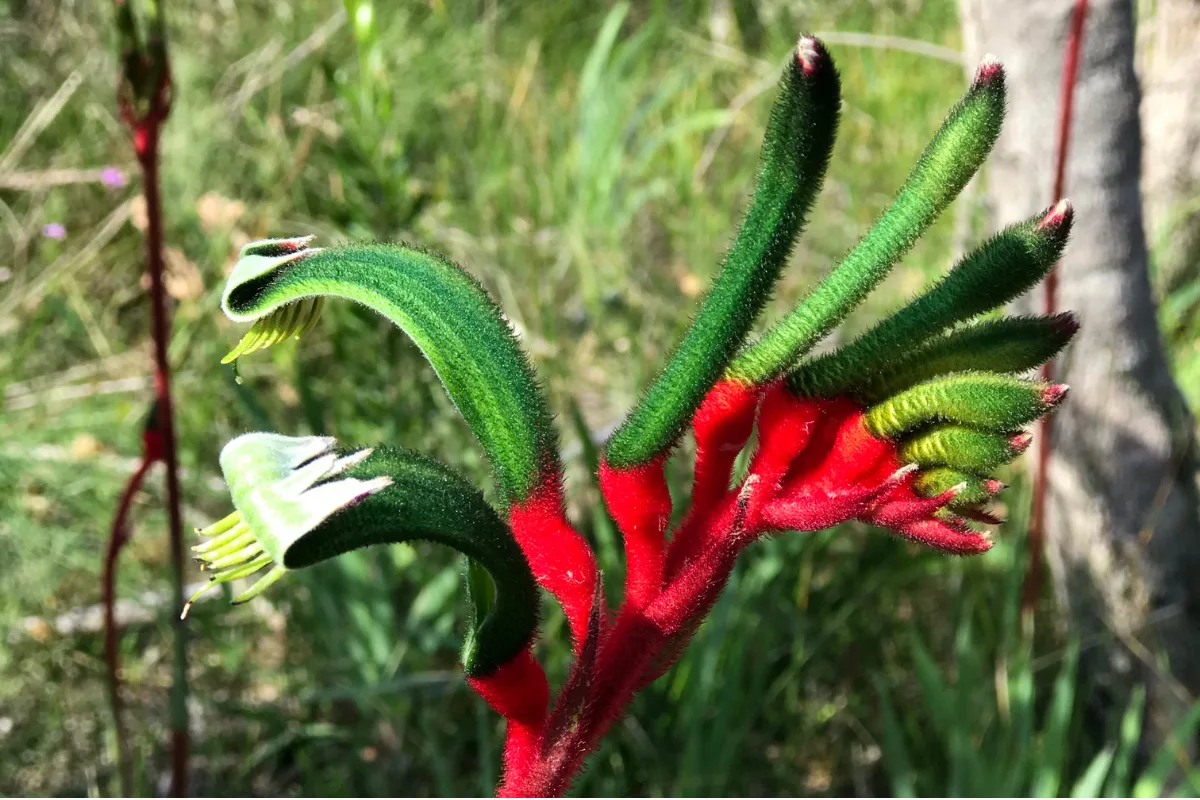
Red and green kangaroo paw is a wonderful spring flower, with bright red stalks and furry green blooms that birds love. Grow several in a sunny, sandy bed, pick a few for the vase and save seed so you can enjoy another display.
 By Elle · Published
- Grows well in
- Mediterranean, Temperate, Subtropical
- Lifecycle
- Rhizomatous perennial herb
- Light
- Full sun, Part shade
- Mature size
- Leafy clump about 30–50 cm across; flower stalks commonly 0.8–1.2 m tall.
- Spacing
- About 40–50 cm between plants in a group, allowing room for air to circulate.
- Growth habit
- Small clumping perennial with underground rhizomes, strappy leaves and upright red-and-green flower stems.
- Native range
- Endemic to western and south-western Western Australia, extending from the Shark Bay area through the Perth region and into the south-west. Includes subspecies manglesii and quadrans.
- Natural habitat
- Sandy heath, shrubland, open woodland and forest, including gravelly lateritic soils in the Darling Range. Flowers mainly from August to November after winter rainfall.
When to plant
Subtropical
April–June
Temperate
September–November
Mediterranean
March–August
Planting
Plant red and green kangaroo paw in autumn or winter in mild parts of Australia. If you get hard frosts, wait for spring. Choose a sunny spot where water drains away quickly. I'd grow it in a raised bed or a big pot if your garden has heavy clay. Water it in well, leave the base of the leaves at soil level and give each clump enough room to spread. A little mulch between the plants helps keep weeds down.
Position and light
Give it plenty of sun for those tall red flower stems and green furry flowers. It can grow with a little light shade, but a sunny, open spot helps the leaves dry after rain. Red and green kangaroo paw grows best where winters bring rain and summers are fairly dry, like much of south-western WA. You can try it in a pot or raised bed in the subtropics, although humid weather makes black ink spot more common. For wet tropical gardens, I'd look at some of the tougher kangaroo paw hybrids instead.
Soil
Red and green kangaroo paw loves sandy loam or gravelly soil. If you've got heavy clay, I'd grow it in a raised bed or a big pot where the roots won't stay wet after rain. Use an open native potting mix in pots, and leave the leafy base uncovered.
Watering
Give new plants regular water while they put down roots. Once they've settled in, check the soil before watering again. In southern WA, many plants slow down over the hot, dry summer, so you can reduce watering then. Water around the base if you can. The foliage is prone to black ink spot, particularly if it stays wet for long periods.
Feeding
At Kings Park, gardeners use a three- to four-month slow-release fertiliser made for Australian natives when planting. That's a good starting point for a pot or sandy garden bed. Follow the label and give another light feed when fresh growth starts if the plant needs it.
Pruning
Once the flowers finish, cut the old flower stalks off near the base. Remove any dead leaves too, but leave the healthy green ones. If you want seed, let a few stalks develop mature seed capsules before cutting them.

Practical uses
A brilliant spring display: Plant several clumps together near a path where you can enjoy the red stalks and green flowers up close. The tall stems look especially good with low native flowers around them.
Dried arrangements: Hang a few cut flower stems upside down somewhere airy and dry. They keep their unusual shape and can be used in dried bunches.

Permaculture uses
A real permaculture garden: In Perth, Josh Byrne planted red and green kangaroo paw along the verge of his permaculture garden. His planting included Grevillea preissii, yellow-flowered Conostylis, rescued grass trees and cycads. You could try something similar along a sunny driveway or on the outside edge of a food forest. Put the kangaroo paws near the front and let the taller shrubs grow behind them.
A waterwise wildlife planting: WA's Water Corporation includes this kangaroo paw in a waterwise verge design with grey cottonheads (Conostylis candicans), native iris (Patersonia occidentalis) and low flowering shrubs. I'd grow a few together in an open, sandy patch. They'll bring honeyeaters into the garden in spring, and their leaves stay low enough to let sunshine reach neighbouring plants. The City of Kalamunda also recommends it as a waterwise plant for local habitat gardens.
Grow your own seed: There's a fascinating reason to plant more than one. Bronwyn Ayre and her fellow researchers found that flowers hand-pollinated with pollen from other kangaroo paws about 1–3 m away produced far more seed than self-pollinated flowers. Try a few seed-grown clumps in the same garden area, where birds can move from one to another. Leave some flower stalks to ripen and you'll have seed for the next planting.

Wildlife and pollinators
At Kings Park in Perth, horticulturist Ali Smith has watched honeyeaters visit kangaroo paw flowers and collect pollen on their heads as they feed. And researchers at the University of Western Australia found something fascinating: when they kept birds away from the flowers, the plants produced 81% fewer seeds and 67% fewer fruits!
The researchers identified brown honeyeaters, singing honeyeaters, western spinebills and white-cheeked honeyeaters visiting the flowers. They also watched silvereyes cut little slits to drink nectar without transferring pollen. European honeybees collected pollen too, but the birds did a far better job of pollinating the flowers. That's a lovely reason to leave a few flower stalks for the birds, even when you're picking some for the vase.
Harvest
Kangaroo paws make gorgeous cut flowers! Pick a stalk when the lowest buds start opening. More flowers will open further up the stalk, so you can enjoy them in the vase as well as in the garden. If you're collecting seed, let a few flower stalks stay on the plant until the capsules turn dry. Shake the seed into a paper bag and label it for your next sowing.
Propagation
You can grow red and green kangaroo paw from seed in a sandy seed-raising mix. Sow in autumn in mild winter-rainfall areas, or spring after frost. Cover the seed lightly and keep the mix moist while the seedlings appear. Australian Native Plants Society reports successful germination without seed treatment. If you'd like to try smoke treatment, Kingsley Dixon's work explains why smoked vermiculite and smoke-water products are used for Australian native seeds. Follow the product's sowing directions. You can also divide a healthy established clump after flowering. Keep several leafy shoots attached to each piece of rhizome, pot them up and water while they establish.
Common problems
Black ink spot: Look for little black spots spreading across the strappy leaves. The disease is more common in humid weather. Give the clump sun and airflow, water around the base and remove leaves that have died. Slugs and snails: Check near the base when young leaves are being chewed, especially after rain. Look under nearby pots and boards too. Root or crown rot: If rain leaves the soil wet for days, lift the plant into a raised bed or grow the next one in a pot with an open mix.
Worth knowing
Western Australia chose red and green kangaroo paw as its floral emblem in 1960.
Companion and understory planting
At Perth's Kings Park Chamelaucium and Anigozanthos Garden, red and green kangaroo paws grow among waxflowers. It's a lovely idea for a sunny native garden. Try some Geraldton wax (Chamelaucium uncinatum) or the smaller-flowered Chamelaucium ciliatum in the same sandy, well-draining bed.
Keep the kangaroo paws in an open area near the front, with taller waxflower shrubs far enough back that they won't shade the leaves. You can enjoy the flower stalks from the path, reach them for cutting and collect seed when the capsules ripen.
Livestock and safety
I haven't found reliable information about red and green kangaroo paw and livestock. I'd keep your new or prized clumps away from grazing animals, just in case!
Tradition and history
Noongar people of south-western Western Australia have names for red and green kangaroo paw including Kurulbrang, Yonga Marra and Nollamara. The Plants and People in Mooro Country publication describes how Noongar people traditionally ate the starchy roots of kangaroo paws, including this one.
Aqwest's Western Australian waterwise plant guide describes the roots being eaten raw or roasted in hot ashes. It also records grinding them into a paste, shaping small cakes and baking them in the ashes.
Growth and roots
Red and green kangaroo paw grows from short underground rhizomes, which make small clumps of strappy leaves. I'd happily plant it along the front of a garden bed or beside a path, where you can reach the flower stalks for cutting. The clumps also grow beautifully in big pots.
You can generally expect two or three good years from a clump in the garden. In Gardening Australia magazine's visit to Kings Park, horticulturist Ali Smith explained that the team plants about 500 seedlings each autumn for the spring display. If you love the flowers, you can keep a new batch coming along from seed.
In the wild, the underground rhizomes can send up fresh shoots after bushfire, as the WA Department of Biodiversity, Conservation and Attractions explains.
References
- Anigozanthos manglesii — Kings Park growing guide
- Chamelaucium and Anigozanthos Garden — Kings Park
- Ayre et al. (2020) — Effectiveness of native birds and honeybees as pollinators of Anigozanthos manglesii
- Ayre et al. (2019) — Near-neighbour optimal outcrossing in Anigozanthos manglesii
- Ayre (2020) — The critical role of birds as pollinators of red and green kangaroo paw, PhD thesis
- Anigozanthos manglesii — Australian Native Plants Society
- Red and green kangaroo paw — Australian National Botanic Gardens, WA floral emblem
- Plants and People in Mooro Country — Noongar plant use, City of Joondalup
- Mangles Kangaroo Paw — Aqwest Waterwise Plants, cultural uses
- Anigozanthos manglesii — WA DBCA commercial harvest management, rhizome and fire
- Anigozanthos manglesii — Kew Plants of the World Online
- A walk in Kings Park — AB Bishop interviews horticulturists Ali Smith and Eloise Barnie
- Smoke Germination of Australian Plants — Kingsley Dixon, Australian Flora Foundation via ANPSA
- Red and green kangaroo paw — Friends of Kings Park species cultivation guide
- Josh Byrne — Permaculture garden and native verge planting, Gardening Australia (2005)
- Water Corporation WA — Popular garden designs for the Mid West, waterwise verge with Anigozanthos manglesii (2017)
- City of Kalamunda — Plants for Residents 2026, Kurulbrang habitat pack
Featured In
Grow Red and green kangaroo paw with Brancho
Add it to My Garden and Brancho works out what it needs next, timed for your climate.
How it grows around Australia
Growing this too? Share what you've noticed in your garden.
Updates appear in My Brancho. Email alerts are not available yet.
Grow a Little Wild
New plants to try, useful growing tips and a few garden jobs based on what you grow.